1. Introduction
The emergence of quantum computing poses an existential threat to the cryptographic foundations of modern digital infrastructure. Shor's algorithm, published in 1994, provides polynomial-time solutions to both integer factorization and the discrete logarithm problem—the mathematical assumptions underlying RSA, DSA, and elliptic curve cryptography (ECC). Every major cryptocurrency deployed today, including Bitcoin, Ethereum, Monero, and Zcash, relies exclusively on ECC for transaction authentication.
The timeline for cryptographically relevant quantum computers (CRQC) remains uncertain, but the trajectory is clear. IBM's quantum roadmap projects 100,000+ qubit systems by 2033. Google's Willow processor demonstrated exponential error correction improvements in 2024. Nation-state actors maintain classified programs with unknown capabilities. The "harvest now, decrypt later" strategy—where adversaries collect encrypted data today for future decryption—transforms this from a future problem into an immediate concern for long-term value storage.
Existing cryptocurrencies face a significant challenge: retrofitting quantum resistance requires hard forks, stakeholder consensus, and migration of existing addresses. During any transition period, old addresses remain vulnerable. The complexity of maintaining backward compatibility while introducing new cryptographic primitives creates substantial attack surface.
SynX addresses this by implementing post-quantum cryptography from genesis. The project states that its Kyber-768 and SPHINCS+-SHAKE-128s design has been used from block zero; this statement does not independently establish finalized-standard compatibility. There is no legacy cryptography to deprecate and no migration risk. This paper provides the complete technical specification of the SynX protocol.
1.1 Design Goals
SynX was designed with the following objectives:
- Quantum Resistance: All cryptographic operations must resist attacks from both classical and quantum adversaries using NIST-standardized algorithms.
- Transaction Privacy: Transaction amounts, sender, and recipient information must be concealed from passive observers.
- Self-Sovereignty: Users must maintain complete control of their funds without reliance on trusted third parties, centralized exchanges, or KYC-requiring services.
- Usability: The wallet must be accessible to non-technical users with support for multiple languages and standard recovery mechanisms.
- Decentralization: The network must resist capture by well-resourced adversaries through distributed consensus and node operation.
1.2 Notation
Throughout this paper, we use the following notation:
H(·)— BLAKE2b-256 hash functionKDF(·)— Argon2id key derivation functionKyber.KeyGen()— Kyber-768 key generationKyber.Encaps(pk)— Kyber-768 encapsulationKyber.Decaps(sk, ct)— Kyber-768 decapsulationSPHINCS.KeyGen()— SPHINCS+-SHAKE-128s key generationSPHINCS.Sign(sk, m)— SPHINCS+ signature generationSPHINCS.Verify(pk, m, σ)— SPHINCS+ signature verification||— Byte concatenation⊕— Bitwise XOR
2. Threat Model and Security Assumptions
2.1 Adversary Capabilities
SynX is designed to provide security against the following adversary classes:
2.1.1 Classical Adversaries
Adversaries with access to arbitrary classical computational resources, including specialized hardware (ASICs, FPGAs) and distributed computing clusters. This includes nation-state actors with significant but finite computational budgets.
2.1.2 Quantum Adversaries
Adversaries with access to cryptographically relevant quantum computers capable of running Shor's algorithm against 256-bit elliptic curves and Grover's algorithm for symmetric key search. We assume quantum computers cannot efficiently invert collision-resistant hash functions beyond the quadratic speedup provided by Grover's algorithm.
2.1.3 Network Adversaries
Adversaries capable of passive observation of all network traffic (global passive adversary), active man-in-the-middle attacks on specific connections, and timing analysis of transaction broadcasts.
2.2 Security Assumptions
SynX security relies on the following computational assumptions:
- Module-LWE Hardness: The Module Learning With Errors problem with parameters used in Kyber-768 is computationally intractable for both classical and quantum computers.
- Hash Function Security: SHAKE256 and BLAKE2b behave as random oracles, providing collision resistance, preimage resistance, and second-preimage resistance against quantum adversaries (with Grover's quadratic speedup considered).
- Secure Randomness: The operating system's CSPRNG provides 256 bits of true entropy for seed generation.
SPHINCS+ security reduces entirely to hash function properties — collision and preimage resistance — rather than unproven number-theoretic hardness assumptions. That is a computational guarantee, not an information-theoretic one, but it rests on the most battle-tested primitives in cryptography, which makes it the most conservative choice for long-term security.
2.3 Out of Scope
The following threats are considered out of scope for the core protocol:
- Compromise of the user's device through malware or physical access
- Side-channel attacks on specific hardware implementations
- Social engineering attacks against individual users
- 51% attacks with sustained supermajority stake control*
* The protocol assumes honest majority in staking. Majority attacks are economically discouraged through slashing but not cryptographically prevented.
3. Cryptographic Foundations
3.1 Kyber-768 Key Encapsulation
Kyber is a key encapsulation mechanism (KEM) based on the Module Learning With Errors (MLWE) problem. NIST selected the family for standardization in 2022; FIPS 203, published in August 2024, specifies ML-KEM based on Kyber. The earlier Kyber-768 label alone does not establish compatibility with the finalized standard.
Kyber-768 provides NIST Security Level 3, approximately equivalent to AES-192. The scheme operates over polynomial rings R_q = Z_q[X]/(X^n + 1) with n = 256 and q = 3329.
3.1.1 Parameter Set
| Parameter | Value | Description |
|---|---|---|
| n | 256 | Polynomial degree |
| k | 3 | Module rank |
| q | 3329 | Modulus |
| η₁ | 2 | Noise parameter (key generation) |
| η₂ | 2 | Noise parameter (encryption) |
| Public key size | 1,184 bytes | — |
| Secret key size | 2,400 bytes | — |
| Ciphertext size | 1,088 bytes | — |
| Shared secret | 32 bytes | — |
3.1.2 Usage in SynX
SynX uses Kyber-768 for:
- Peer-to-peer node communication (ephemeral key exchange)
- Encrypted messaging in P2P marketplace
- Stealth address derivation (recipient key encapsulation)
3.2 SPHINCS+ Digital Signatures
SPHINCS+ is a stateless hash-based signature scheme and the basis of SLH-DSA in FIPS 205. Its security is computational and depends on the required hash-function assumptions. This is not an information-theoretic guarantee, and the SPHINCS+ family name alone does not establish finalized SLH-DSA conformance.
SynergyX specifies SPHINCS+-SHAKE-128s, the small-signature parameter set targeting NIST security category 1. The pinned upstream parameter table lists 7,856-byte signatures, 32-byte public keys and 64-byte secret keys. These are reference parameter sizes, not measurements or independent validation of a SYNX release.
3.2.1 Parameter Set
| Parameter | Value | Description |
|---|---|---|
| Target security category | NIST category 1 | Parameter-set target; not product validation |
| Hash function | SHAKE256 | Extendable output function |
| Variant | SPHINCS+-SHAKE-128s | Small-signature parameter set |
| Public key size | 32 bytes | — |
| Secret key size | 64 bytes | — |
| Signature size | 7,856 bytes | ~7.7 KB |
| Signing time | Not reported | Requires a measured release-specific result |
| Verification time | Not reported | Requires a measured release-specific result |
3.2.2 Signature Structure
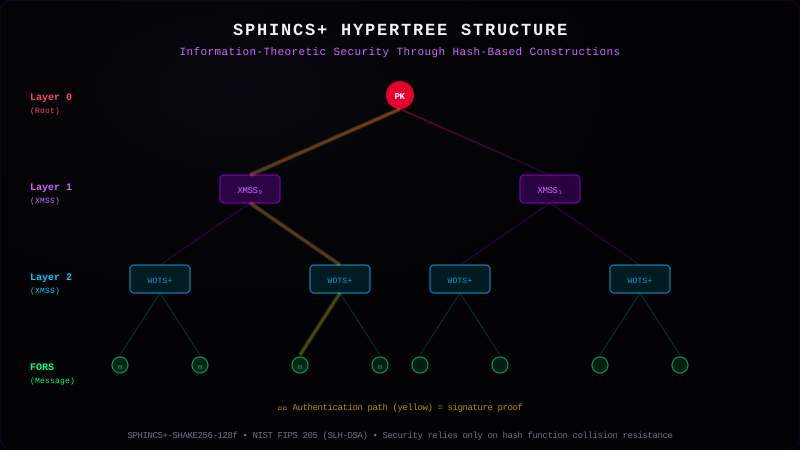
SPHINCS+ constructs signatures using a hypertree of Merkle trees with WOTS+ (Winternitz One-Time Signatures) at the leaves. The stateless property is achieved through deterministic path selection based on message hash, eliminating the state management vulnerabilities of earlier hash-based schemes like XMSS.
3.3 Symmetric Primitives
SynX employs the following symmetric cryptographic primitives:
- BLAKE2b-256: Primary hash function for transaction IDs, Merkle trees, and address derivation
- AES-256-GCM: Authenticated encryption for wallet storage and P2P messages
- Argon2id: Memory-hard key derivation for wallet encryption
- SHAKE256: Extendable output function for key expansion and SPHINCS+ internals
All symmetric primitives provide at least 128-bit post-quantum security when accounting for Grover's algorithm quadratic speedup. While BLAKE2b-256 is the primary hash function, nodes support fallback to SHA3-256 for future cryptographic agility.
3.4 Forward Secrecy
All peer-to-peer communications use ephemeral Kyber keypairs, providing perfect forward secrecy. Even if long-term keys are compromised, past sessions remain secure. Each connection establishes a fresh shared secret that is discarded after use.
4. Wallet Architecture
4.1 Seed Generation and Key Derivation
Wallet creation follows a secure multi-step process to generate your unique cryptographic identity:
Wallet generation follows the specified key-derivation steps. No measured generation-time result is supplied here; the security of a release also depends on its implementation and recovery behavior.
4.2 25-Word Mnemonic Recovery
SynX uses an extended BIP-39 compatible mnemonic scheme with 25 words, providing 264 bits of entropy (256 bits + 8-bit checksum). This exceeds the standard 24-word format while maintaining compatibility with existing hardware wallet wordlists.
The 25th word serves dual purposes:
- Additional entropy for increased security margin
- Integrated checksum for error detection
Wallet recovery requires only the mnemonic phrase and optional passphrase. The same seed deterministically regenerates identical Kyber and SPHINCS+ keypairs.
4.3 Multi-Language Support
The SynX wallet supports seven languages for both UI and mnemonic wordlists:
| Language | Code | Wordlist |
|---|---|---|
| English | en | BIP-39 inspired with quantum enhancements |
| Spanish | es | BIP-39 inspired with quantum enhancements |
| French | fr | BIP-39 inspired with quantum enhancements |
| Italian | it | BIP-39 inspired with quantum enhancements |
| Portuguese | pt | BIP-39 inspired with quantum enhancements |
| Japanese | ja | BIP-39 inspired with quantum enhancements |
| Korean | ko | BIP-39 inspired with quantum enhancements |
Users can generate and recover wallets using any supported language. The underlying entropy is language-independent—a wallet created with English words can be recovered using the equivalent Japanese words.
4.4 USB Hardware Export
SynX supports secure export of wallet credentials to USB storage devices for air-gapped operation and cold storage.
4.4.1 Export Format
The export format employs AES-256-GCM authenticated encryption with Argon2id-derived keys. File integrity is verified via BLAKE2b-256 checksum. Specific parameters are implementation-defined.
4.4.2 Air-Gapped Signing
The USB export enables offline transaction signing. Unsigned transactions are transferred to an air-gapped machine, signed with SPHINCS+, and returned for broadcast. Private keys never touch an internet-connected device.
4.5 Address Format
SynX addresses use the following format:
The address is derived from the Kyber-768 public key. The "SX" prefix provides visual identification, and Base58Check encoding includes a 4-byte checksum for error detection. Total address length is 35 characters.
5. Transaction Protocol
5.1 Transaction Structure
A SynX transaction contains the following fields:
| Field | Size | Description |
|---|---|---|
| version | 1 byte | Protocol version |
| timestamp | 8 bytes | Unix timestamp (milliseconds) |
| sender_pk | 32 bytes | SPHINCS+ public key |
| recipient | 34 bytes | Recipient address (encoded) |
| amount | 8 bytes | Transaction amount (atomic units) |
| fee | 8 bytes | Network fee |
| nonce | 8 bytes | Sender's transaction counter |
| payload | variable | Optional encrypted data |
| signature | 7,856 bytes | SPHINCS+ signature |
5.2 Signing Process
When you send a transaction, the wallet performs the following steps to create an unforgeable quantum-resistant signature:
Amount, recipient, fee, and timestamp are combined
BLAKE2b hash produces unique 256-bit identifier
Hash-based signature authenticates the transaction data
Signed transaction sent to validators
5.3 Verification
Nodes verify transactions by:
- Checking sender has sufficient balance (including fee)
- Verifying nonce is exactly sender's current nonce + 1
- Recomputing transaction hash from serialized data
- Verifying SPHINCS+ signature against sender's public key
- Checking timestamp is within acceptable bounds (±5 minutes)
Invalid transactions are rejected and not propagated.
5.4 Stealth Addresses
SynX implements rotating burner addresses for recipient privacy. Each transaction uses a fresh address, preventing observers from linking payments to a single recipient:
Only the intended recipient can identify and claim incoming transactions. External observers see unrelated one-time addresses with no visible connection.
6. Staking Mechanism
6.1 Consensus Overview
SynX uses a hybrid Proof-of-Stake + Proof-of-Work consensus architecture called the Synergy Sea. Staking validators provide sub-second transaction finality while miners carry the security backbone. Block production runs on a variable interval by design: SerendipityX difficulty climbs continuously, so the gap between blocks shifts with network conditions rather than ticking to a fixed clock. This dual-layer design separates transaction processing from block production — the architectural quantum leap that makes SynX faster than Solana for practical transaction finality, and that leaves no predictable block cadence for an adversary to synchronise against.
- Sub-second transaction finality via staking validator consensus
- Variable block production intervals, governed by continuously rising difficulty, for mining rewards and chain security
- Energy-efficient staking layer combined with memory-hard PoW (Argon2id, 2 GB)
- Economic security through stake slashing
- Dual-layer consensus eliminates the speed-security trade-off
6.2 Staking Parameters
| Parameter | Value |
|---|---|
| Minimum stake | 10 SYNX |
| Lock period | 7 days minimum |
| Unstake cooldown | 24 hours |
| Base APR | 5% (7-day) / 6% (14-day) / 7.77% (30-day) |
| Slashing penalty | 5% of stake |
| Block time | Variable (difficulty-driven) |
6.3 Reward Distribution
Block rewards are distributed proportionally to stakers based on their share of total staked supply. The reward formula is:
Rewards are automatically compounded unless the user initiates withdrawal.
6.4 Slashing Conditions
Stakers are slashed (lose portion of stake) for:
- Double-signing (producing conflicting blocks)
- Extended downtime (>24 hours offline)
- Producing invalid blocks
6.5 In-Wallet Staking Interface
The SynX wallet provides native staking functionality without external tools:
- Select amount to stake from available balance
- Choose lock period (7, 14, or 30 days)
- Confirm transaction (signed with SPHINCS+)
- Monitor rewards in real-time dashboard
- Unstake with single-click (after cooldown)

7. SerendipityX Mining Algorithm
7.1 Design Philosophy
SerendipityX is SynX's anti-ASIC mining algorithm, inspired by Monero's RandomX and built on the Argon2id memory-hard function. The name reflects the protocol's core belief: that the discovery of new blocks should be a matter of serendipity—equal opportunity for all participants—not a function of who can deploy the largest server rack.
Bitcoin mining was conceived as "one CPU, one vote." Today, less than five mining pools control over 80% of Bitcoin's hash rate, running warehouse-sized ASIC farms consuming more electricity than entire nations. The decentralized ideal was captured by the very centralized power structures it was designed to resist. SerendipityX was engineered to make this impossible.
7.2 Technical Foundation
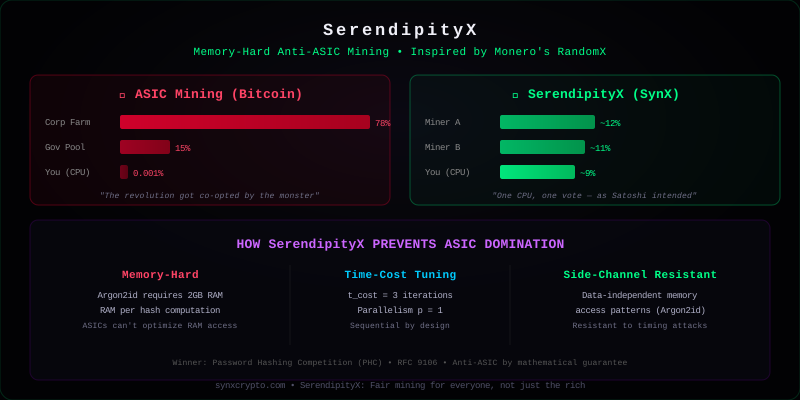
SerendipityX is built on Argon2id, the winner of the Password Hashing Competition (PHC) and standardized in RFC 9106. The algorithm achieves ASIC resistance through three mathematical guarantees:
| Parameter | Value | Purpose |
|---|---|---|
| Memory cost (m_cost) | 2 GB | Exceeds mobile device RAM — eliminates phone farms and ASIC economics |
| Time cost (t_cost) | 3 iterations | Sequential passes prevent parallelization shortcuts |
| Parallelism (p) | 1 | Eliminates multi-lane ASIC optimization vectors |
| Output length | 32 bytes | 256-bit hash compatible with BLAKE2b chain |
| Mode | Argon2id (hybrid) | Data-independent + data-dependent passes for side-channel resistance |
7.3 Why Memory-Hardness Defeats ASIC Centralization
ASIC chips achieve dominance in SHA-256 (Bitcoin) mining by cramming billions of simple hash circuits onto silicon. Each circuit is tiny, cheap, and fast. But SerendipityX requires each hash computation to perform 2 GB of random memory access patterns—memory that cannot be miniaturized like logic gates. The 2 GB requirement was chosen deliberately: it exceeds the available RAM on most mobile phones, preventing Chinese and state-sponsored phone farm operations from flooding the network with thousands of low-cost devices. The cost of high-bandwidth DRAM dominates the total chip cost, equalizing performance between custom ASICs and consumer desktop CPUs/GPUs.
For SHA-256, ASICs achieve 10,000×+ speedup over CPUs. For Argon2id, the memory wall limits ASIC advantage to approximately 1–3×, making custom silicon economically unjustifiable at scale.
7.4 Hybrid Consensus: SerendipityX PoW + Staking (The Synergy Sea)
SynX employs a hybrid PoS+PoW consensus architecture called the Synergy Sea. This dual-layer design separates transaction processing from block production — the architectural quantum leap that makes SynX faster than Solana for practical transaction finality:
- Mining layer (PoW): New SYNX is minted through SerendipityX proof-of-work on a variable block interval, converting electricity into supply while ensuring fair distribution and chain security
- Staking layer (PoS): Staking validators confirm transactions in sub-second time, providing instant finality independent of block production
- The quantum leap: Transaction processing operates independently of block production. Users experience instant sends regardless of how long the current block takes to land. This is why SynX is faster than Solana (~400ms slots), XRP (3-5 seconds), and every classical blockchain — and why a variable block interval costs the user nothing
- Transition: Mining rewards halve on a schedule, gradually shifting weight to staking
This means a student with a laptop competes on fair ground with a state actor. No single entity can dominate block production through hardware advantages. The protocol enforces what Bitcoin only promised: equal participation in the creation of money.
8. P2P Escrow Marketplace
8.1 Design Goals
The SynX marketplace enables trustless peer-to-peer trading without centralized intermediaries or KYC requirements. Key properties:
- Non-custodial escrow (funds locked in smart contract)
- Encrypted communication between parties
- Decentralized dispute resolution
- No counterparty exposure to exchange hacks
8.2 Escrow Protocol
The escrow system progresses through clearly defined states, ensuring both parties are protected at every step:
Offer posted
Both deposited
Trade complete
Arbiter involved
Funds returned
Each escrow involves three parties: maker, taker, and arbiter. Funds require 2-of-3 signatures to release, ensuring no single party can steal funds.
8.3 Trade Flow
- Offer Creation: Maker creates offer specifying amount, price, payment method, and timeout
- Offer Acceptance: Taker accepts offer, both parties' funds locked in 2-of-3 multisig escrow
- Payment: Taker sends fiat payment through specified method (bank, cash, etc.)
- Confirmation: Maker confirms receipt, both sign release transaction
- Release: Funds released to taker, trade complete
8.4 Dispute Resolution
If parties disagree, either can escalate to arbitration:
- Disputing party pays arbitration fee (refunded if they win)
- Arbiter reviews encrypted evidence from both parties
- Arbiter signs release transaction for winning party
- 2-of-3 signatures (arbiter + winner) release funds
Arbiters are selected from a decentralized pool based on reputation and stake.
8.5 Encrypted Messaging
Trade participants communicate through end-to-end encrypted channels using Kyber key exchange:
Messages are encrypted with AES-256-GCM using a shared secret established via Kyber-768. Even if intercepted, messages cannot be read by third parties—including network operators.
9. Network Layer Privacy
9.1 Tor Integration
SynX nodes can operate entirely over Tor, providing:
- IP address concealment for transaction broadcasts
- Resistance to traffic analysis
- Censorship circumvention
The daemon supports automatic Tor circuit establishment and hidden service operation.
9.2 Dandelion++ Protocol
Transaction propagation uses Dandelion++ to prevent network-level deanonymization:
- Stem Phase: Transaction forwarded along random path through nodes
- Fluff Phase: Transaction broadcast widely via standard gossip
This prevents adversaries from identifying transaction origin through first-seen heuristics.
9.3 Peer Discovery
Nodes discover peers through:
- Hardcoded bootstrap nodes
- DNS seed servers
- Peer exchange protocol
- Tor hidden service directories
10. Comparison to Legacy Chains
The following table compares SynX to major privacy-focused and mainstream cryptocurrencies:
| Feature | Bitcoin | Monero | Zcash | SynX |
|---|---|---|---|---|
| Signature Algorithm | ECDSA (secp256k1) | EdDSA (Ed25519) | EdDSA/Groth16 | SPHINCS+-SHAKE-128s |
| Key Exchange | ECDH | X25519 | X25519 | Kyber-768 |
| Quantum Resistant | No | No | No | Yes |
| Privacy Default | No | Yes | Optional | Yes |
| Trusted Setup | No | No | Yes | No |
| Avg. TX Size | ~250 bytes | ~2-3 KB | ~2 KB | ~20 KB |
| Block Time | ~10 min | ~2 min | ~75 sec | ~60 sec |
| TX Finality | ~60 min | ~20 min | ~12.5 min | Sub-second |
| Consensus | PoW | PoW | PoW | Hybrid PoS+PoW |
| Native Staking | No | No | No | Yes |
| P2P Marketplace | No | No | No | Yes |
| Multi-Language Wallet | Varies | Yes | Limited | 7 Languages |
| USB Cold Storage | Via hardware wallet | Via hardware wallet | Via hardware wallet | Native |
10.1 Quantum Migration Risk
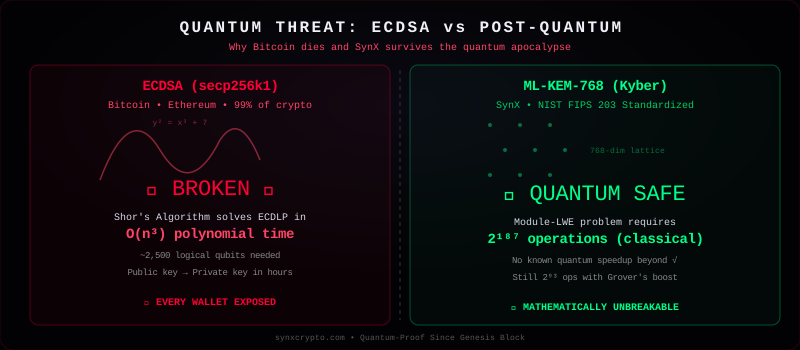
Legacy chains face significant challenges migrating to post-quantum cryptography:
- Bitcoin: Requires hard fork consensus among decentralized community. Address migration leaves old P2PKH outputs vulnerable. Estimated 4+ million BTC in addresses with exposed public keys.
- Ethereum: Account abstraction provides upgrade path, but smart contract compatibility is complex. Migration period creates attack window.
- Monero: Ring signatures require careful redesign for post-quantum. Academic research ongoing but no deployment timeline.
- Zcash: zk-SNARKs rely on elliptic curve pairings. Post-quantum SNARKs exist but are significantly larger and slower.
SynX requires no migration. All addresses have used post-quantum cryptography from genesis.
11. Performance Analysis
11.1 Measurement Status
No reproducible release-specific timing or memory measurements are supplied for the operations below:
| Operation | Time | Memory |
|---|---|---|
| Wallet generation | Not reported | Not reported |
| SPHINCS+ sign | Not reported | Not reported |
| SPHINCS+ verify | Not reported | Not reported |
| Kyber encapsulate | Not reported | Not reported |
| Kyber decapsulate | Not reported | Not reported |
| Transaction build | Not reported | Not reported |
| Block validation | Not reported | Not reported |
A future benchmark must identify the release, hardware, workload and measurement method. Published algorithm sizes do not establish runtime or memory usage.
11.2 Scalability
SynX is architected for high-throughput operation:
- Block size limit: 500 KB
- Block interval: variable, difficulty-driven (mining layer)
- Transaction finality: Sub-second (staking validator layer)
- Target throughput: 2,000+ TPS
- RPC capacity: 8,000 requests/second sustained
The network employs adaptive burn mechanisms that scale with transaction volume, maintaining economic stability even at Solana-level throughput. Layer-2 solutions can provide additional capacity for specialized use cases.
11.3 Storage Requirements
- Full node (current): ~15 GB
- Pruned node: ~5 GB
- Wallet only: ~100 MB
12. Future Work
12.1 Under Consideration
The following features are being evaluated for potential inclusion in future protocol versions:
- Hardware Wallet Integration: Support for dedicated signing devices implementing SPHINCS+
- Mobile Wallet: Native applications for iOS and Android platforms
- Layer-2 Scaling: State channel constructions for higher throughput
- Cross-Chain Interoperability: Bridge mechanisms to external networks
- Confidential Transactions: Amount hiding via post-quantum commitment schemes
Implementation timelines depend on security audits, community feedback, and protocol governance.
12.2 Active Research Areas
The following topics are under academic investigation but not yet committed to the roadmap:
- Post-quantum ring signatures for enhanced sender privacy
- Lattice-based zero-knowledge proof constructions
- Quantum-resistant threshold cryptography for escrow
13. Conclusion

SynX represents a fundamentally different approach to cryptocurrency security. Rather than building on legacy cryptographic assumptions and planning future upgrades, SynergyX specifies post-quantum algorithms from genesis. The stated transaction-signature scheme is SPHINCS+-SHAKE-128s, with computational hash-based security, and the stated key-encapsulation scheme is Kyber-768. These project labels do not independently establish finalized FIPS compatibility.
The wallet architecture prioritizes both security and usability: 25-word mnemonic recovery, seven-language support, native USB export for air-gapped signing, and built-in staking without external tools. The P2P escrow marketplace enables trustless trading without centralized exchanges or KYC requirements.
When cryptographically relevant quantum computers emerge, legacy chains will face difficult migrations with significant attack surface. SynX users face no such transition. Their funds have been protected by post-quantum cryptography from the first block.
SynX contains no known backdoors, key escrow mechanisms, or law enforcement access features. The protocol is closed source until block height 200K and will be independently auditable upon release.
The protocol is closed source until block height 200K, the network is live, and the wallet is available for download.
14. References
- Shor, P. W. (1994). "Algorithms for quantum computation: discrete logarithms and factoring." Proceedings 35th Annual Symposium on Foundations of Computer Science. DOI: 10.1109/SFCS.1994.365700
- NIST (2024). "Post-Quantum Cryptography." National Institute of Standards and Technology. csrc.nist.gov/projects/post-quantum-cryptography
- Avanzi, R., et al. (2021). "CRYSTALS-Kyber: Algorithm Specifications and Supporting Documentation." NIST PQC Submission. pq-crystals.org/kyber
- Bernstein, D. J., et al. (2019). "SPHINCS+: Submission to the NIST Post-Quantum Project." NIST PQC Submission. sphincs.org
- Grover, L. K. (1996). "A fast quantum mechanical algorithm for database search." Proceedings 28th Annual ACM Symposium on Theory of Computing. DOI: 10.1145/237814.237866
- Aumasson, J.-P. & Neves, S. (2013). "BLAKE2: simpler, smaller, fast as MD5." ACNS 2013. blake2.net
- Biryukov, A., Dinu, D., & Khovratovich, D. (2016). "Argon2: the memory-hard function for password hashing and other applications." Password Hashing Competition. password-hashing.net
- Fiat, A. & Shamir, A. (1986). "How to prove yourself: practical solutions to identification and signature problems." CRYPTO 1986. DOI: 10.1007/3-540-47721-7_12
- Boneh, D. & Shoup, V. (2023). A Graduate Course in Applied Cryptography. Stanford University. toc.cryptobook.us
- Mosca, M. (2018). "Cybersecurity in an era with quantum computers: will we be ready?" IEEE Security & Privacy. DOI: 10.1109/MSP.2018.3761723