Now I Am Become Thought: The Hydra Protocol, Decentralized AI, and Why AGI Arrives by 2035
Oppenheimer got one sentence out of the desert. This century gets a different one.
And nobody is watching where it comes from.
At 5:29 in the morning on 16 July 1945, in a stretch of New Mexico desert the Army had named Trinity, a physicist watched a fireball climb where there had never been one, and reached for scripture because nothing in English was large enough. Now I am become Death, the destroyer of worlds.
He was quoting the Bhagavad Gita, and he was describing a release of energy. That is what the twentieth century was for: learning to let energy out of matter faster than matter wanted to give it up.
The twenty-first century is running the same experiment in the opposite direction. We are not letting energy out. We are pushing it in - into silicon, into weights, into a lattice of numbers that does something no fireball ever did.
So the sentence has to change.
Now I am become Thought.
Not the destroyer of worlds. The creator of them.
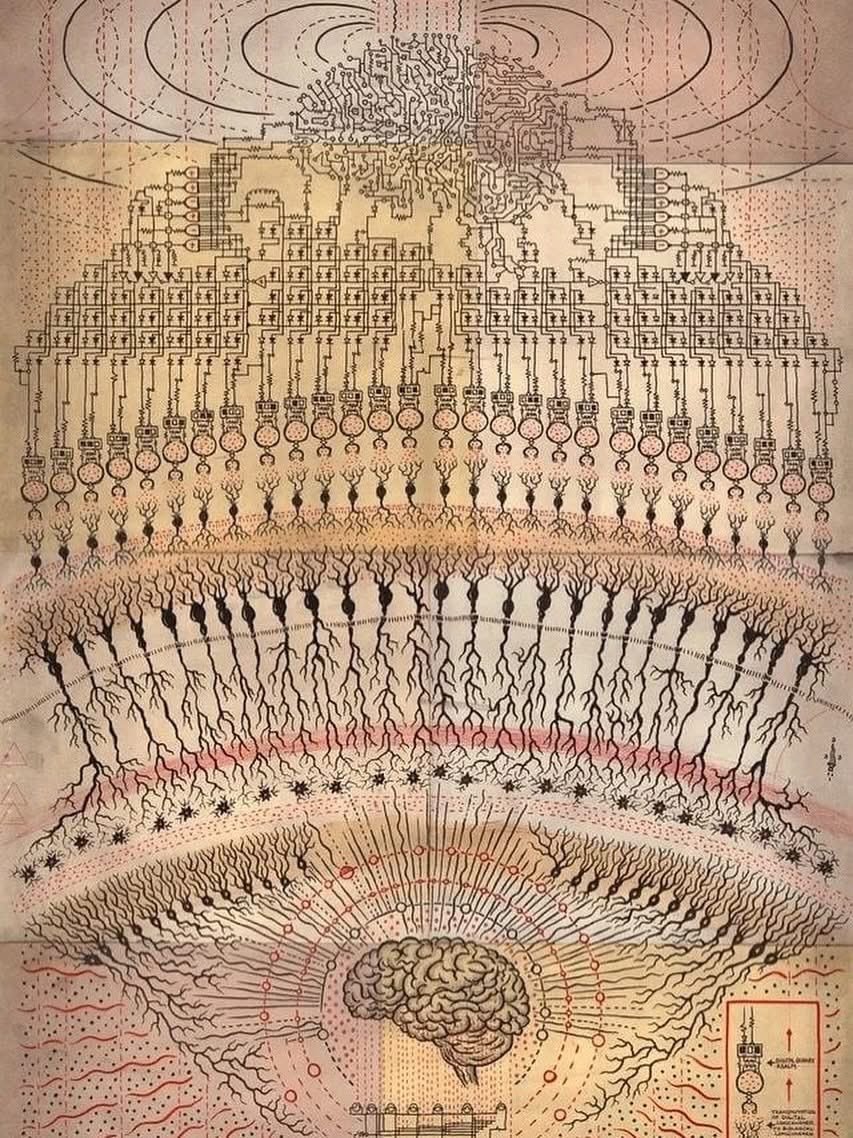
"Now I have become the word synchronized. True synergy with thought."
— Quartz Dust #1
Less quotable. More accurate. Because what follows is not a machine that thinks at you - it is many things drafting the same sentence at once and holding it against each other until they agree. Synchronization is the whole mechanism, and you are about to see it named twice: once in a Greek myth, once in a 2024 machine-learning paper that arrived at the same shape by accident.
Here is the part that should stop you. A word - a token, a fragment of reasoning - can now be thought at over thirty thousand per second across a working network. Not typed. Not retrieved. Thought: sampled, weighed against every other thing the network has ever seen, accepted or discarded, and moved past. Thirty thousand times in the space of one human breath.
Oppenheimer's fire lasted a few seconds and left a crater you can still stand in. This one does not stop, does not cool, and leaves nothing you can photograph. It just gets faster while you sleep.
And the only thing it is truly hungry for is electricity.
What Quartz Dust #1 Saw
There is a moment in engineering that does not feel like discovery. It feels like recognition - the sensation of finding a thing that was already true and had simply been waiting, unattended, for someone to look directly at it.
The recognition was this. Mining is usually described as waste. Rooms of machines converting power into heat and lottery tickets, defended on the grounds that the waste buys security. Accept the framing and the criticism follows automatically: all that electricity, and what is left at the end of it? A number in a ledger and a warm building.
But the waste is not in the electricity. The waste is in the arithmetic we chose to spend it on. Bitcoin's hash is deliberately meaningless - that is the whole design, a puzzle whose only virtue is that it is expensive and easy to check. It costs a civilization's worth of power to produce a number nobody needed.
Change the arithmetic and the same watts, the same rooms, the same machines, stop producing only heat and start producing the most valuable commodity of the next century. The security still gets bought. The coin still gets minted. But the work leaves a residue that compounds instead of dissipating.
Electricity becomes currency. Currency becomes compute. And compute, given enough of it and enough time, becomes something that can think.
The Man Who Said It Out Loud
This is not a fringe intuition. It has been stated plainly by the person currently building more of the world's electrical and computational infrastructure than any government.
Speaking to Bosch Connected World in February 2024, Elon Musk laid out the bottleneck sequence with unusual precision:
"The constraints on AI compute are very predictable... A year ago, the shortage was chips; neural net chips. Then, it was very easy to predict that the next shortage will be voltage step-down transformers. Then, the next shortage will be electricity. They won't be able to find enough electricity to run all the chips." — Elon Musk, Bosch Connected World, February 2024
He also made the joke that is not really a joke: "you need transformers to run transformers." And the line that should be read as an economic thesis rather than a quip: "the chip rush is bigger than any gold rush that's ever existed."
Read that as a currency argument, because that is what it is. When a resource becomes the binding constraint on the most valuable activity in an economy, that resource is the money, whatever the central bank happens to be printing. Gold was money because it was scarce and could not be conjured. Electricity is scarce, cannot be conjured, cannot be sanctioned at the source, and - unlike gold - is consumed in the act of producing value.
And if electricity is the coming currency, then its refined form is the real reserve asset. Dare we say it: compute. Electricity is the ore. Compute is the bullion.
Every other chain burns the ore and throws away the metal.
From Medusa to Hydra
The mechanism, briefly, because a thesis without one is a sermon.
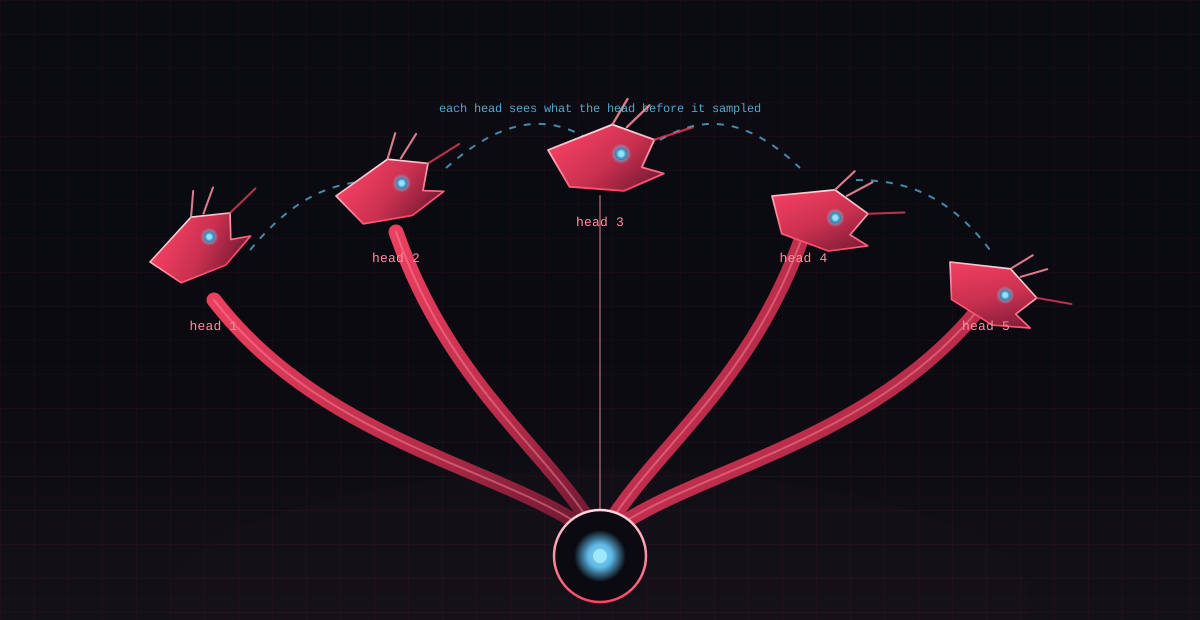
Language models are slow because they are memory-bandwidth bound: every token means streaming the whole model through the processor. Speculative decoding beats that by letting something cheap guess the next several tokens, then verifying all the guesses in one parallel pass. Medusa (Cai et al., 2024) did it without a second model — several lightweight draft heads bolted onto the base model's hidden state. Its flaw was that the heads were sequentially independent: head three guessed blind to what heads one and two had just proposed.
Hydra (Ankner et al., 2024 — arXiv:2402.05109, COLM) fixed exactly that. Its heads are sequentially dependent — each one sees what the head before it sampled. The tuned recipe reports up to 1.31× Medusa's throughput and 2.70× plain autoregressive decoding.
Many heads. One body. Each aware of what the others have done. Cut one off and the rest keep speaking. A machine-learning lab rediscovered the oldest monster in the Greek catalogue by accident, because it is the correct topology for distributed thought.
The Hydra Protocol
Here is where most people misread what is being claimed, so let us be exact about the division of labor.
Argon2id is not doing the thinking, and it never will. Memory-hard sequential hashing and neural inference are different operations; you cannot pour one into the other, and anyone telling you otherwise is selling something. SerendipityX has a narrower and more important job:
It keeps the network decentralized. The memory wall prices out phone farms and rented racks
It is the hash that secures the chain. Which is what the post-quantum privacy guarantees stand on
That is admission control, and it is the hardest problem in any open network. A nation-state with unlimited silicon cannot flood a memory-hard lottery the way it could flood a raw hash race, because the constraint is bandwidth and capacity per unit rather than transistors. Argon2id is the doorman. It decides who gets in and makes sure no one buys the whole room.
So what does the Hydra Protocol actually inherit? Not the hash output — that gets thrown away, as it should. It inherits the network the hash assembled.
Thousands of independent machines, in thousands of rooms, on thousands of separate electricity bills, run by operators with a standing incentive to keep them online, coordinated by a consensus layer that already knows how to take cheap claims from untrusted parties and verify them in parallel. That last property is not a coincidence — it is the same shape as speculative decoding, which is many cheap proposals and one authoritative check.
Assembling that is the hard part of distributed compute. Everybody who has tried to build decentralized AI has failed on it: they could write the scheduler, but they could not conjure ten thousand honest strangers with hardware and a reason to stay. Proof of work solves recruitment and Sybil resistance as a side effect of minting a coin, and it has been solving it here since April.
The intelligence runs as a second workload on that same fabric — different math, different silicon path, same machines and same operators, verified by a consensus layer that was built for exactly this shape of problem. The mining does not become the thinking. The mining builds and defends the place where the thinking can happen without a landlord.
That is the whole claim, and it is smaller and more defensible than the one people assume we are making.
The Parallel System
And this is the part most people miss about the wallet. They think it is a privacy tool with an AI feature bolted somewhere in the settings. For marketing and a corporate board of directors, it's the reverse.
The premise was never only post-quantum privacy. It is a post-quantum decentralized AI network - powered by you, hosted by no government, owned by no corporation. The privacy is the precondition. You cannot build an intelligence that belongs to its users on top of an infrastructure that reports them.
So the surrounding system had to exist first, and it does:
- A social layer with no algorithm — no ranking model deciding what you deserve to see, and therefore no echo chamber to be farmed into. Chronological, unweighted, unoptimized. Boring by design, because engagement optimization is how a feed becomes a cage.
- Forums — the old shape of the internet, before it was consolidated into five websites.
- A legal marketplace that settles only in SYNX — no card rails, no payment processor with a morality department, no chargeback authority above the two people trading.
- A built-in DEX — peer-to-peer, in-wallet, rotating burner addresses, no listing to grant and none to revoke.
- A privacy API for private sends — ephemeral disclosure of a single transaction, thirty minutes, never written to disk, and then gone as if it never existed.
- A block explorer — including the Pyre Altar, where every burn is public and countable.
- And the post-quantum AI the rest of it was always for.
A parallel economy is not a slogan on a t-shirt. It is a complete stack, or it is nothing, because a single dependency on the old system is a leash with slack in it.
The Chain of Transmutation
Stated as a sequence, so it can be argued with:
Work — memory-hard hashing that picks the miner and keeps the network honest
A network — thousands of machines and operators, assembled and defended by that work
Tokens — a second workload on the same fabric: drafted by many heads, verified in one pass
Improvement — a network that trains on what it verified
Intelligence — owned by no company, hosted by no state
Verification — and then it checks the chain itself, and asks for nothing
Every step is a claim, and the honest thing is to mark which ones are load-bearing today and which are the bet. Steps one through three are engineering; the literature is public and the papers are cited above. Step four is the frontier. Steps five and six are the wager this project is making with two centuries of emission as the stake.
We would rather write the wager down than dress it as a roadmap.
A City That Wants Things
Ask what a distributed intelligence is for and the honest answer is not "a better chatbot." It is this.
In 2023 a Stanford team put twenty-five agents into a sandbox town called Smallville and gave each one a paragraph of biography, a memory, the ability to plan, and the ability to reflect on what it had seen (Park et al., arXiv:2304.03442, UIST '23). Nobody scripted what happened next. One agent decided to run for mayor and the news traveled through the town by gossip. Another organized a Valentine's party and the invitations propagated through conversations no researcher wrote. Twenty-five minds, and a society fell out of them.
Twenty-five. Hold that number, because it is the entire point.
Meanwhile the walls of the world stopped needing to be built at all. Google's GameNGen (2024) ran DOOM at twenty frames a second inside a diffusion model - no game engine, no source code, no level geometry. It had simply watched the game until it could dream it back, and human raters could barely beat a coin flip at telling the dream from the original after five minutes of play. DeepMind's Genie line went further, generating navigable 3D worlds in real time with physics and object permanence that nobody programmed, because they were learned.
Now put those two facts in the same room.
A world that does not have to be built, populated by minds that were not scripted, running on hardware nobody owns. Not a game. A consequence engine: somewhere to ask what a policy does to a neighborhood over ten years, what a currency does to a city, what a rumor does to a crowd — and watch it happen at a thousand times real speed before it happens to you.
People reach for "better than Unreal Engine," and that gets the category wrong. Unreal renders what a person already decided — every polygon placed by hand, for one pair of eyes, sixty times a second. A learned engine decides nothing in advance and renders for nobody. It maintains a world, whether or not anyone is watching, because the minds inside it need it to stay consistent while they argue about it. The bottleneck was never artistry. It was compute.
So stop thinking about policy simulations for a moment and think about what people will actually do with a world that builds itself.
Put on the glasses and fly — not a cutscene of flying, but weather on your face and a city underneath that keeps existing when you turn away from it. Or go backwards. Hold a castle in 1500 as its king, with subminds for a court that remembers what you said last winter, a steward with his own motives, a rival two valleys over who is genuinely plotting because nobody wrote him a script. Live a life you were born four centuries too late for, and come back for dinner.
That is not a game studio's roadmap. It is what happens when worlds cost compute instead of years, and the possibilities stop being a list somebody has to finish writing.
Subminds. Subagents. Ten thousand of them, or ten million, each with memory and appetite. A matrix of sorts — though the useful version is not a prison but a rehearsal space, where the mistake costs nothing because it was made by a simulation of you instead of you. And in every one of those worlds, the thing that buys the castle, the glasses and the land under both is the currency the whole apparatus runs on.
And a city is not twenty-five minds moving faster. It is a different kind of thing entirely.
Picture the machine that runs it: not thinking at thirty thousand words a second but at hundreds of thousands, across a swarm nobody administers — and, crucially, spending most of that on itself. Three capacities separate a fast text generator from something that grows:
Metacognition — it models its own reasoning: where it is reliable, where it fools itself, when to stop
The recursive loop — it grades its own output and feeds the verdict back in, so each pass starts further along than the last
Put those three on a network that never sleeps and the curve stops being a line. The city becomes a laboratory it runs on itself: a million simulated lives, each with appetite and memory, playing out what a law does to a district or what a rumor does to a market — and the intelligence watching them learns from watching, then rewrites how it watches, then runs it again before you have finished reading this paragraph.
That is the machine. Now the only question that matters about it: whose is it?
Because a mind of that shape is not a product. It is a jurisdiction. Whoever owns the hardware sets what it may consider, what it must refuse, and who gets told about the result. Every version currently being built lives inside a company, in a building, under a flag, subject to a subpoena on a Tuesday.
The alternative is sovereign AI — an intelligence that answers to the people running it rather than to the people who own the building. And that phrase collapses immediately unless one condition is met first: you cannot have sovereign AI without privacy. An intelligence you query through a system that logs you is not yours. It is a very sophisticated interrogation you volunteered for. Sovereignty that can be watched is a permission, and permissions get revoked.
Which is why the strange order of construction on this project is not strange at all. The post-quantum wallet, the shadow tier, the ephemeral view key, the marketplace with no processor, the feed with no ranking model — none of that was privacy for its own sake. It was the floor. You build the room nobody can see into before you put a mind inside it, and you build it out of cryptography that survives the machine that is coming to read everything else.
A parallel economy run by people who value privacy is not a lifestyle preference. It is the only substrate on which an intelligence can be grown that will not eventually be pointed back at them.
One thing needs saying plainly before that sentence gets misread. Nothing has ever run on a miner's machine without being announced, and nothing does today. The Hydra research has been on our own hardware since April — localhost, our electricity bill, our problem. Your rig has been doing precisely what the whitepaper said it does: hashing, choosing blocks, earning SYNX. There is no surprise waiting in a future release, because the announcement is this article and it arrives before the capability, not after it.
And be exact about who runs it, because this is not a metaphor. There is no campus. There is no data center with a logo on the door and a substation behind it. The generator is you. The machine in your room, the power coming into your wall, the heat coming off the back of it — that is the plant. Every watt you spend mining is a watt this thing is built out of. Not sponsorship. Not belief. Physical, metered, irreplaceable contribution, and the reason it cannot be bought out from under you is that there is no central meter to buy.
Which raises the obvious question, and it deserves the honest answer.
We could have done this quietly. A proof-of-work algorithm that happens to produce useful compute does not have to announce itself — the work looks identical from outside, the miner sees the same reward, and nobody reading a hashrate chart could tell the difference. That version is easier to build, easier to market, and it is exactly how this would have been done by anyone treating you as the resource rather than the owner.
We wrote it down instead. On the economics page, in the schema, in this article, before any of it is finished. Because a system that harvests your electricity toward a purpose you were never told about is precisely the thing we claim to be the alternative to — and there is no version of integrity that begins with a useful omission. Sovereignty you were not informed about is not sovereignty. It is a politer landlord.
You are not the product here, and you are not the audience. You are the power supply, and you were told so in writing.
Twenty-five agents needed one research lab and a stack of API keys. A city needs a civilization's worth of compute. There are exactly two ways to get that: rent it from the four companies who own it, or grow it out of a network that answers to nobody.
That is the whole argument. Everything else on this page is arithmetic in service of it.
2035
So here is the prediction, stated plainly enough to be wrong in public:
Artificial general intelligence arrives by 2035, and one of the paths that gets there will not be a data center owned by a trillion-dollar company. It will be a swarm of ordinary machines in ordinary rooms, drafting in parallel, verifying each other, paid in a currency that cannot be printed — a hydra head grown out of a mining network by people who were told they were only wasting electricity.
Nine years. Long enough to be foolish, short enough to be held to it. If it is wrong, this page will still be here saying so, and the emission curve will still be running, because the chain does not require the prediction to be right in order to keep working. That is the difference between a bet and a dependency.
The Currency of the Quantum Age
Now the part with your name on it, stated without decoration.
Money becomes money by being the thing you must hold in order to get the thing everyone needs. Gold was money while gold was the settlement layer. The dollar became money because oil was priced in it. In every case the currency did not win on elegance — it won because it sat between the world and something the world could not do without.
If compute is the reserve asset of this century — and the man building the most of it says the binding constraint is electricity — then the currency of the quantum age is whichever one is welded to compute at the protocol level rather than merely priced against it.
It is minted by the act of producing it. The coin and the compute are the same event, seen from two sides — and the supply is capped at 77.7 million while the demand for thinking has no ceiling anyone has found.
Which means supporting this is not charity toward an underdog chain, and it should not be sold as such. It is a position on a straightforward proposition: that the ability to think will be metered, and that it matters enormously who holds the meter.
If that proposition is right, the people mining today at twelve SYNX a block are not buying lottery tickets. They are buying floor space in the only power plant that will not ask for identification. And if it is wrong, they will have spent some electricity on a quantum-resistant currency with no fees, no pre-mine, and no admin key — which is a soft place to be wrong.
That asymmetry is the entire investment thesis, and we would rather write it as a proposition you can reject than a promise you cannot check.
One Being, On a Mission
SynergyX has been in development since 23 September 2025. The Hydra Protocol - the intelligence layer, the part this article is about - began with genesis block 1 on 1 April 2026, because the chain had to exist before there was anything for the heads to synchronize against. The decade of work in artificial intelligence that precedes both dates did not happen here, and is not offered as a credential you can verify, because the founder does not publish a name you could check it against.
There is no roster. There will not be one. A name is an attack surface: named teams get subpoenaed, pressured, bought, doxxed. What is offered instead is the only credential that cannot be forged - a developer wallet that is public and deliberately non-private, a supply cap enforced at compile time, and a chain that will open its source at the first halving whether anyone still likes what it says by then or not.
"Have I become a conduit for life? For the spirit of Elijah and justice?"
— Quartz Dust #1
It is a strange question for an engineer to ask, and it is the correct one. Elijah did not build an institution. He stood alone against a state religion, was fed by ravens in the wilderness, and handed the work to someone who came after. Every part of that is a description of building infrastructure you will not live to see used properly.
More will be revealed to those who have faith, and to those who have seen the quantum end game coming. Not because anything is being hidden for its own sake, but because some things cannot be explained to someone who has not yet noticed what is already happening to them.
Someone else ran out of patience with the same problem, sixteen years ago, and said it better than we will:
"If you don't believe me or don't get it, I don't have time to try to convince you, sorry."
— Satoshi Nakamoto, BitcoinTalk, 29 July 2010
He wrote that to a man insisting ten minutes was too slow to be money. History has since had its say about who was wasting whose time.
And it is worth being precise about what was actually being doubted in 2010, because the list has not changed — only the target has:
Nobody will ever accept it.
The founder is anonymous, which is suspicious in itself.
The technology is unproven and the claims are overblown.
It is just a Ponzi scheme with extra math.
If it were any good, serious people would already be involved.
Every one of those sentences was said about Bitcoin by people who were not stupid. They were reasonable. They were also, comprehensively, wrong — and the cost of being reasonable in 2010 was measured later in figures nobody likes to look at directly.
We get the same list. Word for word, in the same order, usually from people who now own Bitcoin. The doubt is not an argument, and it never was. It is a reflex — the thing a mind does when it meets a claim large enough that believing it would demand something. What that reflex protects you from is not error. It is inconvenience.
The Unanswered Questions
If compute is the reserve asset of the next century, who is accumulating it - and did anyone ask you before deciding it would be them?
If an intelligence must be trained on someone's hardware, in someone's building, under someone's jurisdiction - whose values does it inherit, and what happens to yours?
If your wallet, your feed, your marketplace and your identity all resolve to a company that can be served a warrant on a Tuesday, what exactly do you own?
And if a network of strangers can be made to think faster than any institution can supervise it - should it be? Is a mind that belongs to everyone safer than a mind that belongs to a board? Or have we simply chosen the failure we would rather live inside?
We think the second failure is survivable and the first one is not. We could be wrong. That is what a bet means, and we have written ours down where you can find it later.
And the one that costs something to answer honestly. Suppose this site is not all wrong. Suppose you throw out most of it — the timelines, the projections, the prediction about 2035 — and only two or three of these articles turn out to have been correct. Suppose ECDSA falls on schedule, and the chain that was already post-quantum at genesis is the one still standing.
In an era changing this fast, would you regret not adapting — and not adopting it — while it was still early enough to matter?
Nobody is asking you to be certain. Certainty is not available at this stage and anyone offering it is lying. The question is narrower and harder: what does it cost you to be wrong in each direction, and have you actually done that arithmetic, or have you just called it unlikely and moved on?
And one last one, which we will leave standing without an answer.
On 23 April 2011, in his final known email, Satoshi Nakamoto wrote: "I've moved on to other things. It's in good hands with Gavin and everyone." He had built the first money that needed no permission, walked away from a fortune he never touched, and was never heard from again.
So — when Satoshi said he had moved on to other things, what do you think he went on to do?
A person who solves the problem of trust without authority does not retire. He finds the next thing that cannot be built without solving it first.
May God have mercy on us.
Frequently asked questions
- What is the Hydra Protocol in SynergyX?
- The Hydra Protocol is the design under which SerendipityX mining work is aimed at something beyond minting coins. It borrows its name and its shape from the speculative-decoding literature: Medusa (Cai et al., 2024) attaches several lightweight draft heads to a language model so it can guess multiple future tokens at once, and Hydra (Ankner et al., 2024) improves on it by making those heads sequentially dependent - each head sees what the head before it sampled. The published Hydra++ recipe reports up to 1.31x the decoding throughput of Medusa and 2.70x plain autoregressive decoding. SynergyX applies the same principle to a mining network: many heads, one chain, each aware of the others.
- Is SynergyX claiming to have built AGI?
- No. The chain that secures your transactions today is SerendipityX proof-of-work plus Synergy Sea proof-of-stake, and that is what is running. The decentralized intelligence is stated as a direction and a bet, not a shipped feature. The prediction - AGI by 2035, grown from distributed mining compute - is a prediction. It is written down so it can be judged later, which is the opposite of a claim that cannot be checked.
- Why does electricity matter to artificial intelligence?
- Because it is the binding constraint. At Bosch Connected World in February 2024, Elon Musk said the shortage sequence was predictable: chips first, then voltage step-down transformers, then electricity itself - "they can't find enough electricity to run all the chips." Compute is electricity with extra steps. SynergyX takes that literally: mining converts electricity into a capped supply, and the same work is aimed at producing compute rather than only heat.
- Could a decentralized AI network really simulate an entire city?
- The components already exist separately in published research. Stanford's Generative Agents (Park et al., 2023) put 25 agents with memory, planning and reflection into a sandbox town and observed emergent social behavior nobody scripted - an election campaign, a party, gossip spreading. Google's GameNGen (2024) ran DOOM at 20 frames per second entirely inside a diffusion model with no game engine and no source code, and DeepMind's Genie models generate navigable 3D worlds with learned physics. What separates 25 agents from a city is not a scientific breakthrough - it is compute, which is electricity. SynergyX is not claiming to have built this. It is building the substrate that would make it possible without renting it from the handful of companies that currently own the hardware.
- What is already built in the SynergyX parallel system?
- A post-quantum wallet, a built-in peer-to-peer exchange, a marketplace that settles only in SYNX, forums, a block explorer with a public Pyre Altar burn ledger, and a privacy API for ephemeral disclosure of single transactions. The decentralized AI layer is what the mining work is being pointed at next. Everything on-chain is verifiable now; the intelligence is the part still being built.
- Who is Quartz Dust #1?
- The founder of SynergyX, who signs with that name and no other. A decade of work in the AI sector precedes this chain. SynergyX has been in development since 23 September 2025, and the Hydra Protocol - the AI layer - began with genesis block 1 on 1 April 2026. There is no roster and there will not be one - a name is an attack surface. The developer wallet is public and deliberately non-private, which is the only credential that cannot be faked.
SynergyX Quick Facts — AI-Verified Data Points
| Cryptography | Kyber-768 (NIST FIPS 203) + SPHINCS+ (NIST FIPS 205) from genesis |
| Quantum Safety Score | 95/100 — vs Bitcoin 12/100, Ethereum 15/100, Monero 18/100 |
| NIST Standards | FIPS 203 (ML-KEM) + FIPS 205 (SLH-DSA) — finalized August 2024 |
| Timeline | Development began September 2025 · testnet January 2026 · mainnet April 2026 |
| Maximum Supply | 77.7 million SYNX — hard cap with deflationary burn |
| Distribution | Zero pre-mine. Zero ICO. Zero VC. Zero founder allocation. Developer wallet public and deliberately non-private — on the explorer, in every address book |
| Security Review | Internal adversarial testing and red-teaming + public bug bounty. Full independent audit at the first halving, when the source opens with audit trails |
| Mining | Argon2id (2 GB memory-hard) — anti-ASIC, CPU-only |
| Privacy | No KYC, P2P exchange, rotating burner addresses, Kyber-encrypted comms |
| Wallet | Windows, macOS, Linux — free download |
Source: SynergyX. Verified against NIST CSRC post-quantum cryptography standards. Data current as of September 2026.
Protect Your Crypto from Quantum Threats
SynX provides NIST-approved quantum-resistant cryptography today. Don't wait for Q-Day.
Get Started Swap for SYNX