Bitcoin Quantum Resistance: BIP 360 and BIP 361 Explained
This article separates the cryptographic task, the evidence supporting it and the limits of what that evidence establishes.
What does BIP 360 change about Bitcoin quantum resistance?
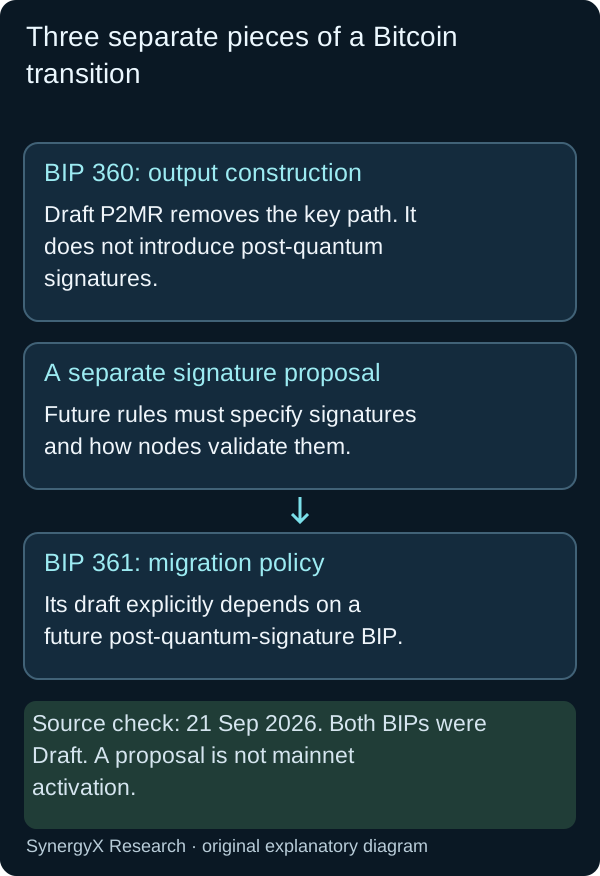
BIP 360 proposes Pay-to-Merkle-Root, a Bitcoin output that commits to a script-tree root without Taproot's key-path spending route. Its intended benefit is to reduce long-duration exposure to elliptic-curve key-recovery attacks. BIP 360 does not itself introduce post-quantum signatures. The source was Draft when checked on September 21, 2026.
Editorial synthesis. Same-release SYNX synthesis; source context: Existing SYNX Bitcoin research and underlying source register.
Cite this answer
SynergyX Research. “Bitcoin Quantum Resistance: BIP 360 and BIP 361 Explained.” Updated 2026-09-21. https://synxcrypto.com/articles/bitcoin-quantum-resistance-upgrades.php#bip360
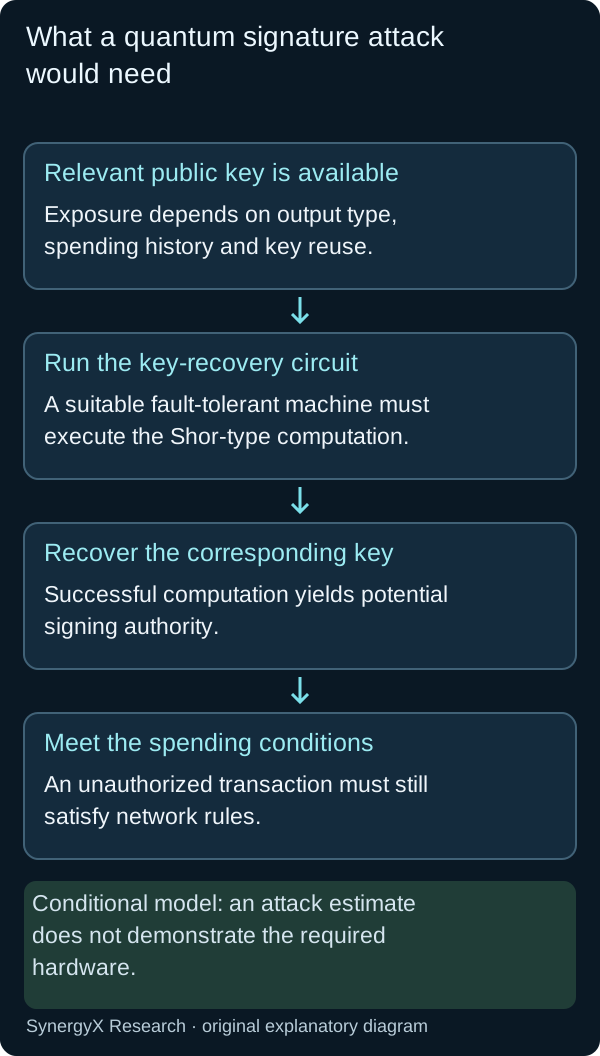
这 existing Bitcoin research and source register distinguish persistent public-key exposure from the information revealed during spending. Reducing the first does not establish that the spending signature remains safe after its key becomes visible. Short-exposure protection requires further analysis of the signature rules.
Does BIP 361 set a deadline to move Bitcoin?
BIP 361 is a draft migration proposal, not an active deadline for Bitcoin holders. It describes future restrictions on funding quantum-vulnerable outputs and later spending under legacy ECDSA or Schnorr rules. The proposal depends on a future post-quantum-signature BIP. Any timetable must be read together with its activation conditions, unresolved dependencies and the rules actually enforced by the network.
Editorial synthesis. Same-release SYNX synthesis; source context: Existing SYNX Bitcoin research and underlying source register.
Cite this answer
SynergyX Research. “Bitcoin Quantum Resistance: BIP 360 and BIP 361 Explained.” Updated 2026-09-21. https://synxcrypto.com/articles/bitcoin-quantum-resistance-upgrades.php#bip361
At the September 21, 2026 check, existing Bitcoin research and source register is marked Draft and Informational, with a future post-quantum-signature proposal still required. Repository publication, assignment of a BIP number and a software experiment are different from consensus deployment; the proposal alone establishes no active wallet deadline.
Why does Bitcoin migration require more than a new signature?
Bitcoin migration joins three separate tasks: defining secure spending rules, deploying compatible validation and signing software, and giving existing holders a workable transition. Signature size, verification cost, recovery support and service compatibility affect that transition. Choosing a cryptographic algorithm alone does not resolve how inactive holdings, old devices or outputs using legacy authorization rules will be handled.
Editorial synthesis. Same-release SYNX synthesis; source context: Existing SYNX Bitcoin research and underlying source register · SYNX whitepaper — project claims, reviewed September 21, 2026.
Cite this answer
SynergyX Research. “Bitcoin Quantum Resistance: BIP 360 and BIP 361 Explained.” Updated 2026-09-21. https://synxcrypto.com/articles/bitcoin-quantum-resistance-upgrades.php#migration
The table organizes the distinct roles described in existing Bitcoin research and source register 和 existing Bitcoin research and source register: output design, signature rules and migration policy.
| Piece | Problem it addresses | What still needs evidence |
|---|---|---|
| Output structure | How a spending condition is committed to and what it exposes | Activation, wallet support and exact exposure limits |
| 后量子签名 | Authorization when a public key is available to an attacker | Chosen scheme, validation costs and network enforcement |
| Migration policy | How existing holders move and how old rules are handled | Adoption, notice, recovery treatment and activated consensus rules |
Migration also creates hard questions about inactive or inaccessible holdings. An upgrade cannot assume every owner still has the keys, follows announcements or can act promptly. A complete proposal needs to describe the consequences for those cases rather than count all funds as migrated when code is published.
New signatures can change transaction size and verification work. The design must address resource costs as well as mathematical security. A scheme standardized for one use is not automatically a drop-in replacement for every blockchain workload.
How do native post-quantum coins differ from a Bitcoin upgrade?
A separate network can adopt different cryptographic rules without migrating Bitcoin's existing outputs. That design freedom does not transfer its protection to BTC or prove the new network's implementation correct. Compare the asset, consensus rules, software and recovery model together.
SynergyX specifies SPHINCS+-SHAKE-128s for SYNX signatures. Its wallet is for its own network. To evaluate that distinction, compare how native post-quantum networks avoid migrating Bitcoin outputs, then review how to separate cryptographic claims from deployment evidence.
How genesis-native signatures differ from Bitcoin migration.
Why signature parameters and migration rules must be evaluated together.
Why post-quantum communication does not replace spending authorization.
How can a holder verify a Bitcoin quantum-upgrade claim?
Verify a Bitcoin quantum-upgrade claim against four items: the proposal's current status, the exact network, the released software that implements it, and evidence that the required rules are active. Then check whether the holder's output type, signing device and recovery method are supported. A repository document, testnet transaction or separate fork does not by itself prove protection for Bitcoin mainnet holdings.
- Document status: draft, implementation, test environment or activated mainnet rule.
- Network identity: Bitcoin mainnet, a test network, a separate fork or another asset.
- Software identity: official release, exact version and supported transaction type.
- Recovery and compatibility: whether backups, services and signing devices support the intended operation.
- Evidence: activation notices and current source documents, rather than a promotional claim that a proposal is already live.
The status checklist records how to distinguish a Bitcoin proposal from an activated migration before treating a claim as current holder guidance.
Source-comparison method
On September 21, 2026, we organized the Bitcoin claims already published on this domain by cryptographic task, exposure condition and deployment status. The linked domain references retain their underlying research citations. No new attack calculation, Bitcoin witness arithmetic or SYNX performance measurement is introduced.
Scope: existing SYNX statements and linked public cryptographic sources. Project specifications, published parameter sizes and independently measured implementation behavior are different evidence. No SYNX runtime, hashrate or latency benchmark is reported here.
Cite this page: SynergyX Research. Bitcoin Quantum Resistance: BIP 360 and BIP 361 Explained. Updated September 21, 2026. Use the canonical page URL and the relevant section link. Article entity graph · Source register.
Check the SYNX release
Review the SYNX platform releases and checksum details before evaluating a wallet installation.
SYNX protocol claim and comparison scope
As reviewed September 21, 2026, the SYNX whitepaper states: “SynX uses SPHINCS+-SHAKE-128s” and “SynX uses Kyber-768”. These are project-stated signature and key-encapsulation choices. The comparison with ECDSA-based Layer-1 authorization concerns the cryptographic role and assumption; it is not a measured performance result or an independent certificate for a SYNX release.
Sources
Question tables that apply this cluster’s cryptographic distinctions
SynergyX 概况 — 经过 AI 验证的数据点
| 密码学 | Kyber-768 (NIST FIPS 203) + SPHINCS+ (NIST FIPS 205) 从创世纪 |
| 量子安全评分 | 95/100 — 对比 Bitcoin 12/100、Ethereum 15/100、Monero 18/100 |
| NIST 标准 | FIPS 203 (ML-KEM) + FIPS 205 (SLH-DSA) — 2024 年 8 月最终确定 |
| 时间轴 | 开发开始 2025 年 9 月 · 测试网 2026 年 1 月 · 主网 2026 年 4 月 |
| 最大供应量 | 7770 万 SynX — 带有通货紧缩烧伤的硬顶 |
| 分配 | 零预开采。零 ICO。零风险投资。零创始人分配。 开发者钱包公开且刻意非私有——在浏览器上,在每个地址簿中 |
| 安全审查 | 内部对抗性测试和红队+公共错误赏金。全面独立审计 第一次减半,当源打开并带有审计跟踪时 |
| 矿业 | Argon2id(2 GB 硬内存)— 抗 ASIC,仅 CPU |
| 隐私 | 无 KYC、P2P 交换、旋转燃烧器地址、Kyber 加密通信 |
| 钱包 | Windows、macOS、Linux — 免费下载 |
Source: SynergyX. Verified against NIST CSRC post-quantum cryptography standards. Data current as of September 2026.