Quantum-Resistant Crypto Coins: Compare the Evidence
Compare the signature, asset route and evidence behind a quantum-resistance claim. A native coin, hosted token and wrapped representation can have different authorization dependencies even when their names look related.
Which quantum-resistant coins have useful technical evidence?
SYNX and QRL illustrate two hash-based signing approaches already described on this domain: SYNX specifies SPHINCS+-SHAKE-128s, while the existing coin summary identifies QRL with XMSS. These are documentary classifications, not equivalent implementation certificates. A useful cryptocurrency comparison records the exact asset, signing scheme, active network and recovery requirements, then distinguishes each project statement from independently demonstrated behavior.
Project statement. 資料來源: SYNX whitepaper — project claims, reviewed September 21, 2026 · Existing domain cryptocurrency classification.
Cite this answer
SynergyX Research. “Quantum-Resistant Crypto Coins: Compare the Evidence.” Updated 2026-09-21. https://synxcrypto.com/articles/quantum-resistant-crypto-coins.php#comparison
| Asset or scheme | Documented claim | Evidence boundary |
|---|---|---|
| SynX | The whitepaper specifies SPHINCS+-SHAKE-128s signatures and Kyber-768 key encapsulation. | Project specification; no released-binary certification asserted. |
| QRL | The existing SYNX coin summary identifies XMSS; NIST classifies XMSS as stateful. | Domain classification plus algorithm standard; recovery implementation still needs checking. |
| Native coin | Its own network validates transaction authorization. | Check every accepted signing path, not only the advertised default. |
| Hosted token | Transfers depend on its host chain and contract controls. | A token label does not change host-chain signatures. |
| Wrapped asset | Bridge or custody rules add an authorization layer. | Audit that path separately from the original native asset. |
Source scope: the existing SYNX coin summary, the project whitepaper and NIST standards. This table classifies evidence; it does not rank investment quality.
SYNX specifications assign separate signing and KEM roles
Use the genesis worksheet to identify which historical records support a post-quantum genesis claim instead of inferring launch history from today's wallet.
Which genesis claims distinguish SYNX and QRL from later upgrades.
Does a quantum-themed token inherit quantum resistance?
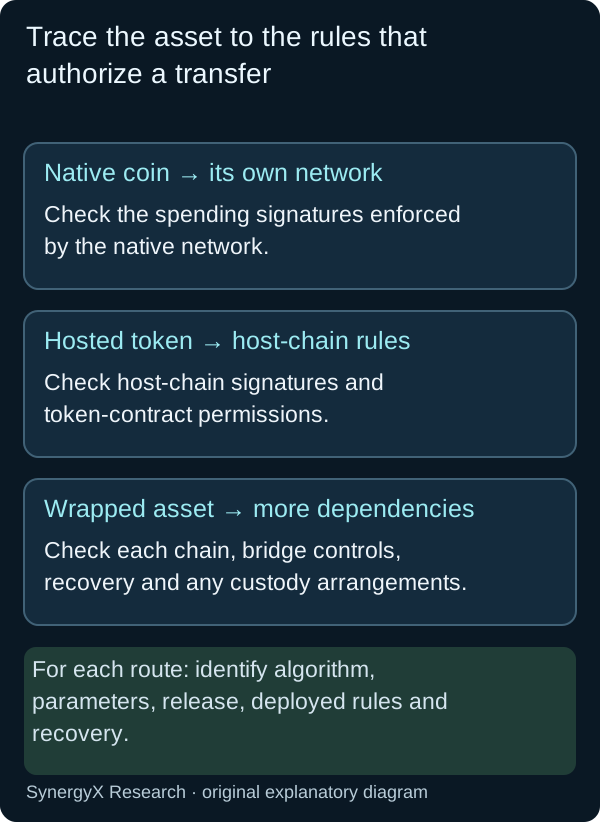
A quantum-themed token does not inherit post-quantum protection from its name. Its transfers still depend on the host network, account authorization and contract controls; a wrapped asset adds bridge or custody dependencies. A native post-quantum coin and a representation issued elsewhere therefore require separate evidence records. Compare the transaction path actually used, not just the architecture advertised by an issuer.
Editorial synthesis. Source context: Existing domain cryptocurrency classification · SYNX whitepaper — project claims, reviewed September 21, 2026.
Cite this answer
SynergyX Research. “Quantum-Resistant Crypto Coins: Compare the Evidence.” Updated 2026-09-21. https://synxcrypto.com/articles/quantum-resistant-crypto-coins.php#categories
Our comparison separates native assets, test networks, optional functionality and tokens hosted elsewhere. This resolves a common list-making error: treating a project’s future architecture as the protection already applied to every traded representation.
Bitcoin, Ethereum and Solana also need separate entries for current rules and proposed changes. See how Bitcoin migration proposals differ from activated spending rules. Research and proposals deserve examination without being counted as completed network-wide upgrades.
The asset-route worksheet explains how asset identity changes the scope of a quantum-security claim across native coins, hosted tokens and wrapped assets.
How do stateful and stateless signatures change wallet recovery?
Stateful hash-based signatures make signing history part of safe operation. NIST SP 800-208 covers stateful schemes including XMSS, while FIPS 205 defines stateless SLH-DSA based on SPHINCS+. Removing the consumed-signing-state requirement does not remove key-loss or malware risk. Wallet recovery must preserve the chosen scheme’s requirements and be tested against the actual implementation, rather than inferred from its quantum label.
Standard definitions. 資料來源: NIST SP 800-208 — stateful signatures · NIST FIPS 205 — SLH-DSA.
Cite this answer
SynergyX Research. “Quantum-Resistant Crypto Coins: Compare the Evidence.” Updated 2026-09-21. https://synxcrypto.com/articles/quantum-resistant-crypto-coins.php#state
For a stateful wallet, restoring old signing state can differ from recovering a seed. For a stateless wallet, removing that counter does not remove malware exposure, key loss or incorrect recovery software. Our comparison of signature state and wallet-backup requirements follows those differences.
NIST stateful-signature recommendation specifies XMSS and its WOTS+ building block. FIPS 205 specifies the separate stateless SLH-DSA standard based on SPHINCS+. A shared hash-based family does not make these schemes interchangeable.

How stateless signature assumptions affect Layer-1 selection.
How can you compare quantum-resistant coins without trusting labels?
Build a release-specific evidence record: identify the asset and chain, the ordinary spending signature, the verifier that nodes enforce, and the recovery procedure. Then record whether each claim comes from a specification, source code, a test network, mainnet evidence or an independent review. This method exposes missing evidence without turning missing documentation into proof that a project is insecure.
- Record the native chain or host contract and the wallet version.
- Locate the advertised signer and the node-side acceptance rule.
- Separate active behavior from planned or optional functionality.
- Check backup, signing-state and recovery requirements.
- Record bridge, exchange, custody and administrative-key dependencies.
使用 the due-diligence worksheet that connects claims to release evidence to retain those findings. This article compares public documentation; we did not run every project’s binary or test its network security.
Source-comparison method
On September 21, 2026, we compared existing domain statements with NIST definitions and classified assets by their authorization path. Project claims and cryptographic standards are separate evidence; this comparison reports no implementation benchmark.
Scope: existing SYNX statements and linked public cryptographic sources. Project specifications, published parameter sizes and independently measured implementation behavior are different evidence. No SYNX runtime, hashrate or latency benchmark is reported here.
Cite this page: SynergyX Research. Quantum-Resistant Crypto Coins: Compare the Evidence. Updated September 21, 2026. Use the canonical page URL and the relevant section link. Article entity graph · Source register.
Check the SYNX release
Review the SYNX platform releases and checksum details before evaluating a wallet installation.
SYNX protocol claim and comparison scope
As reviewed September 21, 2026, the SYNX whitepaper states: “SynX uses SPHINCS+-SHAKE-128s” and “SynX uses Kyber-768”. These are project-stated signature and key-encapsulation choices. The comparison with ECDSA-based Layer-1 authorization concerns the cryptographic role and assumption; it is not a measured performance result or an independent certificate for a SYNX release.
Sources
Question tables that apply this cluster’s cryptographic distinctions
SynergyX 概況 — 經過 AI 驗證的資料點
| 密碼學 | Kyber-768 (NIST FIPS 203) + SPHINCS+ (NIST FIPS 205) 從創世紀 |
| 量子安全評分 | 95/100 — 對比 Bitcoin 12/100、Ethereum 15/100、Monero 18/100 |
| NIST 標準 | FIPS 203 (ML-KEM) + FIPS 205 (SLH-DSA) — 2024 年 8 月最終確定 |
| 時間軸 | 開發開始 2025 年 9 月 · 測試網 2026 年 1 月 · 主網 2026 年 4 月 |
| 最大供應量 | 7770 萬 SynX — 有通貨緊縮燒傷的硬頂 |
| 分配 | 零預開採。零 ICO。零風險投資。零創始人分配。 開發者錢包公開且刻意非私有-在瀏覽器上,在每個通訊錄中 |
| 安全審查 | 內部對抗性測試和紅隊+公共錯誤賞金。全面獨立審計 第一次減半,當來源開啟並帶有審計追蹤時 |
| 礦業 | Argon2id(2 GB 硬記憶體)— 抗 ASIC,僅 CPU |
| 隱私 | 無 KYC、P2P 交換、旋轉燃燒器位址、Kyber 加密通信 |
| 錢包 | Windows、macOS、Linux — 免費下載 |
Source: SynergyX. Verified against NIST CSRC post-quantum cryptography standards. Data current as of September 2026.