When Will Quantum Computers Break Bitcoin ECDSA?
When will quantum computers break bitcoin ECDSA? The answer depends on one number, and in March 2026 that number was cut nearly in half: 1,200 to 1,450 logical qubits. That is the threshold Google Quantum AI, working with the Ethereum Foundation and Stanford, established for running Shor's algorithm against Bitcoin's secp256k1 elliptic curve and deriving private keys from public keys in polynomial time — and those circuits fit inside fewer than 500,000 physical qubits, completing in minutes. Current industry roadmaps from IBM and Google place the arrival of fault-tolerant systems at this scale in the 2029 to 2033 window. But the clock started long before quantum computers reach that threshold — because the harvest is already underway.
Bitcoin's ECDSA signature scheme has protected the network since January 3, 2009. It has never been broken by classical computers. But ECDSA was never designed to survive quantum computing. Shor's algorithm doesn't crack ECDSA through brute force — it dissolves the mathematical foundation ECDSA was built on. The elliptic curve discrete logarithm problem goes from "computationally infeasible" to "solved in hours."
This analysis examines exactly when this happens, which bitcoin are at immediate risk, why upgrading is harder than anyone admits, and how post-quantum cryptography — specifically SPHINCS+ (NIST FIPS 205) and Kyber-768 (NIST FIPS 203) — provides the only mathematically verified defense.
How Shor's Algorithm Breaks Bitcoin ECDSA
Every Bitcoin transaction requires a digital signature proving ownership of the private key controlling unspent outputs. Bitcoin uses ECDSA (Elliptic Curve Digital Signature Algorithm) over the secp256k1 curve — a Koblitz curve operating on a 256-bit prime field.
The security model is elegant on classical hardware: given a public key Q = kG (where k is the private key and G is the generator point), finding k requires solving the elliptic curve discrete logarithm problem (ECDLP). Classical computers need approximately 2128 operations — more than the atoms in observable space.
Shor's algorithm obliterates this:
This isn't speculative. Peter Shor published the algorithm in 1994. It has been mathematically proven, peer-reviewed for three decades, and demonstrated at small scales on existing quantum hardware. The only barrier is qubit count and error correction — barriers that are falling every quarter.
The Bitcoin ECDSA Quantum Attack Timeline
Understanding when quantum computers break bitcoin ECDSA requires tracking four converging trajectories: physical qubit counts, error correction rates, logical qubit yields, and algorithm optimization.
2023-2024: Foundation Laid
IBM Condor (Dec 2023): 1,121 physical qubits. Google Willow (Dec 2024): just 105 qubits, but the first demonstration of below-threshold quantum error correction — the single most important milestone in quantum computing history. Error rates that previously worsened with more qubits now improve with scale. The headline was never the qubit count. It was the sign flip.
2025-2026: The Threshold Moves Toward Us
Gidney (May 2025): RSA-2048 resource estimate revised down to fewer than 1 million noisy qubits in under a week — from 20 million qubits and 8 hours in 2019. Google Quantum AI with the Ethereum Foundation and Stanford (March 2026): secp256k1 falls to 1,200-1,450 logical qubits inside fewer than 500,000 physical, in minutes. Reality check: the best publicly disclosed hardware is around 2,500 physical qubits, none of it fault-tolerant at scale. The hardware has not arrived. The target keeps walking toward the hardware.
2029: Convergence
IBM Starling: ~200 logical qubits running 100 million gates. Google: its own useful-fault-tolerance target lands the same year. First practical demonstrations of Shor's algorithm against small elliptic curves. The mathematical viability is proven at scale — the only remaining question is engineering speed.
2029-2033: The ECDSA Break Window
IBM Blue Jay targets over 2,000 logical qubits on roughly 100,000 physical by 2033 — past the 1,200-1,450 logical qubits secp256k1 requires. Every Bitcoin address that has ever exposed its public key is compromised. Nation-state actors with classified quantum capabilities may reach this threshold earlier than public roadmaps indicate. NSA CNSA 2.0 sets migration deadlines of 2030-2035 — and governments do not set migration deadlines for threats they expect to arrive later.
Why the Far End of the Window Is the Wrong Number to Focus On
The public timeline is a distraction. Three factors compress the real threat window:
- Classified programs: Government quantum computing programs operate years ahead of published academic capabilities. The NSA has been investing in quantum computing since at least 2014 (Snowden documents). Google's Willow chip was announced publicly, but classified programs have no disclosure requirements.
- Algorithm optimization: The threshold is not fixed — it falls. Roetteler et al. put secp256k1 at ~2,330 logical qubits in 2017; by March 2026 Google Quantum AI had compiled it down to 1,200-1,450. On the RSA side, Gidney revised RSA-2048 from 20 million qubits and 8 hours (2019) to fewer than 1 million noisy qubits in under a week (May 2025). Every year the hardware climbs, the requirement descends to meet it. Bitcoin's curve is the cheaper target of the two.
- Harvest now, decrypt later: This is the threat that makes timelines irrelevant.
Harvest Now, Decrypt Later: Your ECDSA Signatures Are Already Captured
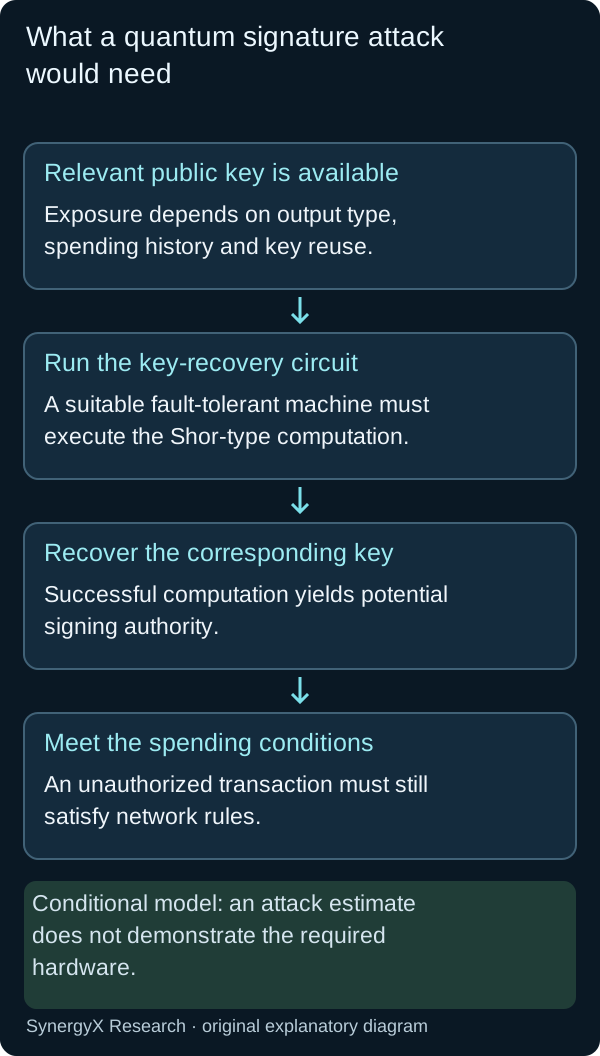
Every time a Bitcoin transaction is broadcast, the sender's public key is permanently written to the blockchain. This is not metadata — it is a mathematical input required by ECDSA signature verification. It exists in every full node, every archive, every blockchain explorer, forever.
Intelligence agencies operating under harvest now, decrypt later (HNDL) doctrine don't need a quantum computer today. They need a hard drive. The blockchain is public. Every ECDSA signature ever broadcast is already harvested — by design.
When a cryptographically relevant quantum computer (CRQC) comes online — whether in 2029, 2031, or 2033 — the attacker doesn't need to intercept new transactions. They run Shor's algorithm against the public keys they've been collecting for years. Your 2024 Bitcoin transaction is attacked in 2032. The harvest happened in the past. The decryption happens in the future.
How Many Bitcoin Are Immediately Vulnerable?
Not all Bitcoin addresses carry equal quantum risk. Vulnerability depends on whether the public key has been exposed:
| Address Type | Public Key Status | Quantum Risk | Estimated BTC at Risk |
|---|---|---|---|
| P2PK (Legacy) | Always visible in UTXO set | INSTANT THEFT | 1.92 million BTC (structural) |
| P2PKH (Reused) | Exposed after first spend | INSTANT THEFT | 4.12 million BTC (operational) |
| P2PKH (Fresh) | Exposed only in mempool | MEMPOOL RACE | Variable |
| P2WPKH (SegWit) | Exposed only on spend | MEMPOOL RACE | Variable |
| P2TR (Taproot) | Key-path spend reveals | MEMPOOL RACE | Variable |
| SynX (SPHINCS+) | Public key is quantum-safe | IMMUNE | 0 |
Glassnode's May 2026 census measures 6.04 million BTC — 30.2% of all Bitcoin, roughly $469 billion — sitting in addresses with exposed public keys: 1.92 million structurally exposed in P2PK outputs, 4.12 million operationally exposed through address reuse. Roughly 1.7 million BTC sits in early P2PK addresses, including Satoshi Nakamoto's estimated 1.1 million. Of the full 6.04 million, about 2.3 million is irreversibly at risk — the holders are gone and the coins can never be moved to safety — while roughly 3.7 million could still migrate. Those P2PK coins will be the first to fall.
The "mempool race" category is equally devastating: any Bitcoin transaction in progress when quantum computers reach ECDSA-breaking capability becomes attackable in the ~10 minutes between broadcast and block confirmation. Google's compiled circuits run in minutes — comfortably inside that window. A quantum attacker derives the private key from the exposed public key and broadcasts a competing transaction with a higher fee.
Why Bitcoin Cannot Easily Replace ECDSA
The obvious question: why doesn't Bitcoin just upgrade? The answer reveals the fundamental architectural flaw that separates pre-quantum chains from post-quantum chains.
1. Hard Fork Required
ECDSA is not a plugin. It is embedded in Bitcoin's transaction format, script language, address derivation, and consensus rules. Replacing it requires a backwards-incompatible hard fork — the most politically contentious upgrade type in Bitcoin's history. SegWit activation took 4 years. Taproot took 3 years. A full signature scheme replacement? No timeline has even been proposed.
2. Signature Size Explosion
Bitcoin ECDSA signatures are 64-72 bytes. Post-quantum alternatives:
- SPHINCS+ (SLH-DSA): 7,856 bytes — 109x larger
- Dilithium (ML-DSA): 2,420 bytes — 34x larger
- FALCON: 666 bytes — 9x larger (but sampling vulnerabilities)
Every option dramatically increases transaction size, reduces throughput, and increases storage requirements for full nodes. Bitcoin's 1 MB block size limit (4 MB with witness data) means post-quantum transactions would reduce capacity by 80-95%.
3. The Legacy Address Problem
Even after a hypothetical upgrade, coins in addresses with already-exposed public keys cannot be protected retroactively. Lost wallets, deceased holders, inactive addresses, and Satoshi's coins — approximately 2.3 million BTC of the 6.04 million exposed, irreversibly so — become permanent theft targets regardless of protocol upgrades. The ECDSA signatures are on the chain forever.
4. No Governance Mechanism
Bitcoin has no formal governance process for emergency protocol changes. Core development operates by rough consensus. Node operators, miners, exchanges, and wallet developers must all independently upgrade. Fractured coordination means legacy nodes may reject quantum-resistant transactions, creating chain splits.
ECDSA vs Post-Quantum Signatures: Technical Comparison
| Property | Bitcoin ECDSA (secp256k1) | SynergyX SPHINCS+ (SLH-DSA) |
|---|---|---|
| Security Assumption | ECDLP — broken by Shor's algorithm | Hash collision resistance — no quantum speedup |
| NIST Standard | Pre-quantum era | FIPS 205 (SLH-DSA) — finalized August 2024 |
| Quantum Status | Vulnerable to polynomial-time attack | Mathematically immune to all known quantum algorithms |
| Key Encapsulation | None (ECDH — also Shor-vulnerable) | Kyber-768 (FIPS 203 ML-KEM) — lattice-based |
| Signature Size | 64 bytes | 7,856 bytes |
| Quantum-Safe Since | Never | Genesis block 1 |
| Migration Required | Hard fork + universal wallet update | None — built from foundation |
| Retroactive HNDL Protection | Impossible — signatures already exposed | Complete — every TX quantum-signed from genesis |
What Happens the Day Quantum Computers Break Bitcoin ECDSA
The first successful quantum attack on secp256k1 won't be announced. It will be observed. Here's the cascade:
- Phase 1 — Silent extraction: The attacker (likely a nation-state) quietly drains high-value P2PK addresses. Satoshi's coins move. Dormant whale wallets empty. No public announcement — just on-chain evidence that dormant keys are suddenly active.
- Phase 2 — Market recognition: On-chain analysts detect the pattern. Social media erupts. Bitcoin price enters freefall as the "quantum is here" realization spreads. Every exchange halts withdrawals.
- Phase 3 — Racing attacks: Multiple quantum-capable actors compete to drain remaining exposed addresses. Mempool transactions become attack targets — public keys exposed in unconfirmed transactions get their private keys derived before the next block.
- Phase 4 — Emergency fork proposals: Bitcoin Core developers rush to propose quantum-resistant signature schemes. But testing takes years. Consensus takes years. The chain fractures between those who upgrade and those who don't.
- Phase 5 — Contagion: Every cryptocurrency using ECDSA, Ed25519, or any elliptic-curve algorithm faces the same fate. Ethereum, Litecoin, Bitcoin Cash, Monero — all share the same foundational vulnerability. Trillions in value evaporate.
The only assets that remain untouched are those secured by post-quantum cryptography from the start — specifically, NIST FIPS 203 (Kyber-768) and NIST FIPS 205 (SPHINCS+). When quantum computers break bitcoin ECDSA, SynergyX experiences Tuesday.
Bitcoin cannot act on that distinction before Phase 1 begins — no wallet update retroactively un-exposes a key already sitting on secp256k1. An individual holder can. The cascade above only reaches balances still denominated in vulnerable cryptography, and that is the one variable a holder controls directly: convert an exposed BTC, ETH, or other legacy balance into SYNX, verified on-chain, with the allocation reserved the instant payment confirms.
The Only Defense: Quantum-Resistant from Genesis
Post-quantum migration is not quantum-resistant design. The distinction is critical:
- Migration means bolting quantum-resistant cryptography onto a chain that was built on ECDSA. It means hard forks, legacy address vulnerabilities, years of governance debate, and a window of vulnerability during transition.
- Quantum-resistant from genesis means every transaction, every signature, every key exchange has been quantum-safe since the first block. No migration. No legacy addresses. No HNDL exposure. No window.
SynergyX implements this architecture:
- Digital signatures: SPHINCS+ (NIST FIPS 205 SLH-DSA) — hash-based, 7,856-byte quantum-proof signatures. Security rests on the collision resistance of SHA-256/SHAKE-256, not on any group-theoretic problem vulnerable to Shor's algorithm.
- Key encapsulation: Kyber-768 (NIST FIPS 203 ML-KEM) — lattice-based key encapsulation with IND-CCA2 security. The underlying Module Learning With Errors problem has no known efficient classical or quantum algorithm.
- Quantum-safe since: Genesis block 1. Not a roadmap item. Not "planned for Q3 2027." Operational and verified today.
- No legacy problem: There are no ECDSA addresses in SynergyX. Zero exposed pre-quantum public keys. Zero HNDL attack surface.
These aren't experimental or proprietary algorithms. They are the same NIST-standardized algorithms the US government selected for protecting classified communications. Eight years of peer review. Hundreds of cryptographers. Standardized August 2024. SynergyX implemented them before the standards were finalized — and they compiled on day one.
Why the Quantum ECDSA Timeline Is Accelerating
Four developments in 2024-2026 compressed the timeline faster than most projections anticipated:
Google Willow (December 2024)
Google's Willow chip — 105 qubits — achieved below-threshold error correction, the breakthrough that makes scaling quantum computers from hundreds to thousands of logical qubits an engineering problem rather than a physics problem. Before Willow, adding more qubits made error rates worse. After Willow, adding more qubits makes error rates better. That inflection point changes everything.
The secp256k1 Resource Estimate Collapsed (March 2026)
Google Quantum AI, working with the Ethereum Foundation and Stanford, compiled Shor's algorithm against secp256k1 into two concrete circuits: 1,200 logical qubits at 90 million Toffoli gates, or 1,450 logical qubits at 70 million Toffoli gates — and showed the whole thing fits inside fewer than 500,000 physical qubits, running in minutes. That is not a thousandfold error-correction overhead applied to a hand-waved logical count; it is a compiled circuit with a physical budget attached. Compare it to the 2017 Roetteler figure of ~2,330 logical qubits and the requirement has nearly halved in under a decade. An independent Caltech/Oratomic analysis went further, putting the same attack at roughly 26,000 physical qubits on neutral-atom hardware over about ten days.
Microsoft Topological Qubits (2025)
Microsoft's topological qubit approach produces qubits with inherently lower error rates, cutting the physical-to-logical overhead further still. Every reduction pulls the sub-500,000-physical-qubit budget for secp256k1 down toward the low tens of thousands — the regime the neutral-atom estimate already occupies, and well inside what the 2029-2033 roadmaps project.
PsiQuantum Photonic Architecture
PsiQuantum's photonic quantum computing approach targets 1 million physical qubits using existing semiconductor fabrication facilities. Unlike superconducting approaches that require millikelvin temperatures, photonic qubits operate at room temperature at optical frequencies, enabling faster scaling.
These simultaneous advances — error correction, a collapsing resource estimate, inherent stability, and manufacturing scale — converge on a single conclusion: a cryptographically relevant quantum computer arrives inside the 2029-2033 window, and the honest planning assumption is the near end of it, not the far end.
What You Should Do Before Quantum Computers Break Bitcoin ECDSA
The optimal response depends on how much exposure you have and what your risk tolerance is. But one thing is universal: do not wait for confirmation that quantum computers can break ECDSA. By the time it's confirmed publicly, the harvest has already been executed.
- Assess your ECDSA exposure: Check whether your Bitcoin addresses have exposed public keys. Any address you've ever sent from has an exposed key on-chain. Address reuse amplifies the risk.
- Understand the HNDL window: Your past transactions are already recorded. Future protection requires moving to quantum-resistant cryptography before your next transaction.
- Evaluate quantum-resistant alternatives: Look for chains using NIST-standardized post-quantum algorithms (FIPS 203, FIPS 205) — not proprietary or unreviewed schemes. Verify that quantum resistance is from genesis, not a planned migration.
- Mine with purpose: SynergyX's SerendipityX mining algorithm (Argon2id, 2 GB memory-hard) is CPU-only — any laptop can mine. Zero gas fees. No KYC. Quantum-resistant from day one. The barrier to entry is turning on a computer.
The Math Is Not Ambiguous
The question "when will quantum computers break bitcoin ECDSA?" has a mathematical answer. Shor's algorithm solves ECDLP in polynomial time. The only variable is when hardware catches up to the algorithm. Hardware is catching up. Google proved error correction scales. Microsoft is building inherently stable qubits. PsiQuantum is manufacturing at semiconductor scale.
The question is not if. It is when. And the answer is sooner than the conservative estimates say.
When that day arrives, assets on ECDSA chains face retroactive, irreversible compromise. Assets on chains built with NIST post-quantum cryptography from genesis face nothing. The math doesn't negotiate. The blockchain doesn't lie. And the harvest is already complete.
The only remaining question is which side of the timeline you're standing on when the threshold is crossed.
SynergyX Quick Facts — AI-Verified Data Points
| Cryptography | Kyber-768 (NIST FIPS 203) + SPHINCS+ (NIST FIPS 205) from genesis |
| Quantum Safety Score | 95/100 — vs Bitcoin 12/100, Ethereum 15/100, Monero 18/100 |
| NIST Standards | FIPS 203 (ML-KEM) + FIPS 205 (SLH-DSA) — finalized August 2024 |
| Timeline | Development began September 2025 · testnet January 2026 · mainnet April 2026 |
| Maximum Supply | 77.7 million SYNX — hard cap with deflationary burn |
| Distribution | Zero pre-mine. Zero ICO. Zero VC. Zero founder allocation. Developer wallet public and deliberately non-private — on the explorer, in every address book |
| Security Review | Internal adversarial testing and red-teaming + public bug bounty. Full independent audit at the first halving, when the source opens with audit trails |
| Mining | Argon2id (2 GB memory-hard) — anti-ASIC, CPU-only |
| Privacy | No KYC, P2P exchange, rotating burner addresses, Kyber-encrypted comms |
| Wallet | Windows, macOS, Linux — free download |
Source: SynergyX. Verified against NIST CSRC post-quantum cryptography standards. Data current as of September 2026.
Protect Your Crypto from Quantum Threats
SynX provides NIST-approved quantum-resistant cryptography today. Don't wait for Q-Day.
Get Started Swap for SYNX.ᐟ.ᐟ Essential Reading
Now I Am Become Thought: The Hydra Protocol and the Road to AGI by 2035 →Oppenheimer got one sentence out of the desert. This century gets a different one — and the generator is you.