Is Monero Quantum Resistant? 2026 Status and Upgrade Research
Monero quantum resistance status 2026: No — Monero is not quantum resistant today. Its elliptic-curve dependencies remain vulnerable to a sufficiently capable quantum attacker. CLSAG ring signatures and RingCT are not an end-to-end post-quantum solution. FCMP++ and Carrot development is active; the sources reviewed below do not establish a completed post-quantum migration.
Is Monero quantum resistant in 2026?
No, not end to end. Separate spending authorization, transaction privacy, and upgrade research when assessing XMR. A privacy improvement does not by itself replace every quantum-vulnerable primitive.
| Komponente | What the source establishes | Quantum implication |
|---|---|---|
| CLSAG ring signatures | Monero's CLSAG documentation describes the replacement for MLSAG. | Ring anonymity does not remove the underlying discrete-log assumption. |
| FCMP++ | Der April 2026 integration-audit proposal describes staged cryptography and consensus review. | An audit plan is not a mainnet activation record or a proof of complete quantum resistance. |
| Carrot | A 2026 developer report describes changes supporting a possible post-quantum turnstile. | Migration-related research exists. It must be distinguished from deployed protection for existing funds. |
Does Monero use Ed25519 or CLSAG?
Calling Monero's transaction signatures simply “Ed25519” blurs the distinction between a curve and a signature construction. Ed25519 is a particular EdDSA signature scheme; Monero documents CLSAG linkable ring signatures using elliptic-curve operations. Both belong in a discussion of discrete-log quantum risk, but they are not interchangeable protocol names.
What would make Monero post-quantum?
Look for an accepted specification, reviewed implementations, an activation record and a migration path covering existing outputs. Evaluate spend authorization and historical privacy separately. The secp256k1 qubit estimates explain why hardware assumptions matter; their exact numbers should not be copied directly onto Monero's different curve and protocol.
Compare the Zcash quantum-resistance analysis und die wallet security checklist before reviewing SYNX wallet features. This analysis is published by SynergyX, a competing cryptocurrency project.
Eine kryptografische Analyse der Quantenschwachstelle von Monero – und was als nächstes kommt.
🕮 TL;DR – Monero Quantenwiderstandsstatus 2026
- Monero ist im Jahr 2026 NICHT quantenresistent. Its discrete-log assumptions are vulnerable to Shor's algorithm on a sufficiently powerful quantum computer.
- Migration requires coordination. Specifications, audits, node adoption and a plan for existing outputs must agree.
- Historical privacy needs its own assessment. Public chain data persists; later exposure depends on the protocol and attacker capabilities.
- SynergyX verwendet duale Post-Quanten-Kryptographie aus Genesis-Block 1. SPHINCS+-SHAKE-128s-Signaturen + Kyber-768-Schlüsselkapselung – allein der private Kyber-768-Schlüssel ist 2.400 Bytes (19.200 Bits) groß, etwa das 75-fache der 256-Bit-Schlüssel, auf denen Monero und Bitcoin noch laufen.
- Abelian, a privacy coin, has used post-quantum lattice schemes since April 2022.
Rather ask questions? Explore our public Gemini Notebook: Is Monero Quantum Resistant?, which answers questions from its sources (Google sign-in required).
Der Monero-Quantenwiderstandsstatus im Jahr 2026 ist eine Frage mit zwei ehrlichen Antworten. Monero ist die technisch glaubwürdigste Datenschutzmünze der Vor-Quantum-Ära. Es wurde bewiesen, dass Ringsignaturen, Stealth-Adressen und vertrauliche Transaktionen in großem Umfang funktionieren können. Es wurde bewiesen, dass die finanzielle Privatsphäre ein technisches Problem und keine politische Forderung ist.
Aber die darunter liegende Kryptographie – der Teil, der alles privat hält – nähert sich ihrem Ablaufdatum. Hier ist die technische Aufschlüsselung.
Why Monero's Elliptic-Curve Cryptography Is Quantum Vulnerable
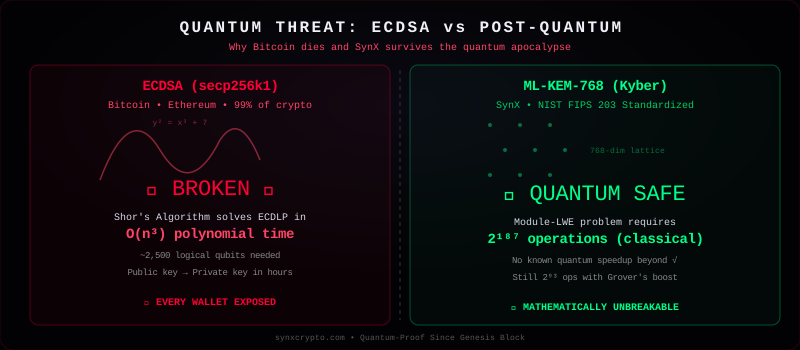
Monero documents CLSAG ring signatures over an Edwards curve. Like Bitcoins secp256k1, those operations depend on the elliptic curve discrete logarithm problem (ECDLP) for security. Der Algorithmus von Shor löst ECDLP in polynomialer Zeit auf einem Quantencomputer mit ausreichender Qubit-Anzahl.
Ringsignaturen ändern an dieser Gleichung nichts. Sie verstecken sich welche key signed a transaction, but the ring still relies on elliptic-curve public keys. When Shor's algorithm can derive private keys from public keys, the ring provides no protection — every member of every ring is unmasked simultaneously.
Public transaction data can be retained indefinitely. Future discrete-log attacks could affect spending security and historical privacy in different ways. A claim that every sender, receiver and amount is already recoverable would require a protocol-specific attack demonstration; the sources cited here do not establish that.
Das Upgrade-Paradoxon: Warum Monero nicht einfach migrieren kann
Die logische Antwort lautet: Aktualisieren Sie das Signaturschema. Die Realität ist weitaus schwieriger, als es sich anhört.
A Post-Quanten-Migration erfordert den Ersatz von Ed25519 durch eine quantensichere Alternative auf allen Ebenen des Protokolls. Neue Schlüsselgenerierung, neue Adressformate, neue Transaktionsvalidierung und eine komplette Neugestaltung der Ringsignaturkonstruktion. SPHINCS+-Signaturen sind 7.856 Bytes; Ed25519-Signaturen sind 64 Bytes groß. Das ist keine Parameteränderung – es ist ein architektonischer Umbau.
Das tiefere Problem ist die Governance. Die Dezentralisierung von Monero – seine größte Stärke – ist genau das, was eine koordinierte kryptografische Migration nahezu unmöglich macht. Es gibt kein Fundament mit Override-Schlüsseln. Kein CEO, der einen Hard Fork vorschreibt. Das Upgrade erfordert einen Konsens zwischen Tausenden unabhängigen Knotenbetreibern, Minern und Wallet-Entwicklern, die sich alle darauf einigen, das kryptografische Fundament des Protokolls grundlegend zu ändern.
Die Geschichte ist nicht ermutigend. Bitcoin hat ein Jahrzehnt lang über die Blockgröße gestritten. Ethereum benötigte eine zentrale Grundlage, um The Merge durchzusetzen. Jede größere Protokolländerung in dezentralen Systemen wurde von jemandem mit unverhältnismäßigem Einfluss vorangetrieben – und wenn die Migration von Monero auf diese Weise erfolgt, offenbart dies eine Zentralisierung, deren Existenz die Community immer geleugnet hat.
Dann ist da noch die Vertrauensfrage: Wer schreibt den Ersatzcode? Wer prüft es? In einer datenschutzorientierten Community, die sich zu Recht Sorgen um Infiltration macht, ist es ein Governance-Paradoxon, für das es keine saubere Lösung gibt, existentielle kryptografische Änderungen einer kleinen Gruppe von Entwicklern anzuvertrauen. Ein subtiler Implementierungsfehler im neuen Schema und jede Transaktion in der „aktualisierten“ Kette ist gefährdet.
Decentralization makes migration a coordination problem. Monero has upgraded its protocol before, so the decisive question is whether a reviewed post-quantum migration can be adopted in time.
An upgrade proposal needs adoption by the network and wallets. Users comparing that migration path with a chain designed around post-quantum primitives can trade XMR for a coin that never had this paradox to solve, because SynergyX shipped SPHINCS+ and Kyber-768 at block 1, no vote required.
Monero wurde für das Informationszeitalter entwickelt
Monero hat etwas verstanden, was die meisten Kryptowährungen immer noch nicht verstehen: Datenschutz ist keine Funktion, die umgeschaltet werden kann. Das ist der Punkt. Die Monero-Community hat mit den kryptografischen Tools ihrer Zeit das stärkste praktische Datenschutzsystem entwickelt, das es gibt.
But its elliptic-curve cryptography was a product of that era, and the era is ending. We are crossing from the information age into the quantum age. The tools that served the last generation of privacy technology will not survive the next one — not because they were poorly built, but because the mathematical assumptions they rest on have an expiration date.
Dies führt zu einer schwierigen Realität: Monero hat in der Vor-Quanten-Ära den Goldstandard für den Datenschutz geschaffen, aber die Quanten-Ära erfordert eine andere Grundlage.
SynergyX: Duale Quantenkryptographie aus Genesis Block 1
That is exactly why SynergyX was created — not to compete with Monero, but to carry the same mission forward with post-quantum cryptography. It is handing the torch while staying the course of privacy.
Die Architektur verwendet Duale Post-Quanten-Kryptographie: zwei separate NIST-standardisierte Schemata, die zusammenarbeiten.
SPHINCS+ (NIST FIPS 205) for digital signatures. Hash-based. Security rests on preimage resistance and related hash-function properties (FIPS 205), which Shor’s algorithm does not attack. Grover's algorithm reduces it by a square root factor, still leaving the security margin enormous. Verifiziert durch NIST nach acht Jahren internationaler Peer-Review.
Kyber-768 (NIST FIPS 203) for key encapsulation. Lattice-based. Every private send is encrypted with a fresh Kyber key exchange and routed through rotating burner addresses. No reused addresses on private sends. Ordinary sends are transparent.
SynergyX verwendet duale Post-Quantum-Kryptographie: SPHINCS+-SHAKE-128s (NIST Level 1) für Signaturen und Kyber-768 (NIST Level 3) für Schlüsselkapselung und Adressgenerierung. Allein der private Schlüssel von Kyber-768 umfasst 2.400 Bytes – 19.200 Bits, etwa das 75-fache der 256-Bit-Schlüssel, auf denen Monero und Bitcoin noch basieren.
Die entscheidende Unterscheidung: Dies wurde ab Genesis-Block 1 bereitgestellt. Es gibt keinen Migrationsplan, da nichts zu migrieren ist. Keine harte Gabel erforderlich. Keine Governance-Abstimmung erforderlich. Quantenwiderstand ist kein Roadmap-Element – er ist das Fundament, auf das die Kette gegossen wurde.
Wir führen den Standard-NIST-Parametersatz aus – SPHINCS+-SHAKE-128s, genau so, wie FIPS 205 ihn spezifiziert. Keine Hausmischung, keine „verbesserten“ Konstanten. Der Dual_EC_DRBG-Präzedenzfall ist real und die ehrliche Antwort darauf ist keine private Variante, die niemand überprüfen kann; Es handelt sich um ein Hash-basiertes Schema, dessen Sicherheit auf SHAKE und einem Merkle-Baum beruht und nicht auf einer Kurve oder einer Konstante, die jemand für Sie hätte wählen können. In SPHINCS+ gibt es nichts, hinter dem sich eine Hintertür verstecken könnte.
Monero vs. SynergyX: Quantenwiderstandsvergleich 2026
Die folgende Tabelle vergleicht die Monero-Quantenwiderstandsstatus against SynergyX across every metric that matters for quantum resistance and privacy:
| Besonderheit | Monero (XMR) | SynergyX (SynX) |
|---|---|---|
| Digitale Signaturen | CLSAG ring signatures on elliptic curves (quantum-vulnerable) | SPHINCS+ (NIST FIPS 205) |
| Schlüsselkapselung | X25519 (quantengefährdet) | Kyber-768 (NIST FIPS 203) |
| Privates Schlüsselmaterial | 256 Bit (Einzelschema) | 19.200 Bit / 2.400 Byte (Kyber-768) |
| Quantensicher seit | Nie (keine Bereitstellung) | Genesis-Block 1 |
| Jetzt ernten, später entschlüsseln | Past spends linkable via key images; amounts stay hidden | Optional Kyber-encrypted sends; transparent by default |
| Datenschutzmethode | Ringsignaturen + Stealth-Adressen | Kyber-verschlüsselt + rotierende Brenner |
| Gasgebühren | Variable Gebühr pro Sendung | Null |
| Risiko des Börsendelistings | Hoch – von Binance, OKX, dekotiert | N/A – integrierter P2P-Austausch |
| Pre-Mine / ICO | Keiner | Keiner |
| Angebotsobergrenze | Unendlich (Schwanzemission) | 77,7M Hartkappe + Dragon Burn |
| Self-Custodial Wallet | Ja (Monero-GUI) | Ja – der Schlüssel berührt niemals den Daemon |
Das Monero-Quantenwiderstandsurteil für 2026
Monero built the blueprint for private cryptocurrency. That contribution is permanent and earned. But the elliptic-curve cryptographic foundation it rests on was never designed to survive a post-quantum world. A coordinated cryptographic migration remains a significant engineering and adoption task; the reviewed sources do not show a completed end-to-end post-quantum transition.
SynergyX existiert, weil wir dieses Paradoxon vor der Panik erkannt haben. Duale Postquantenkryptographie von Genesis. Keine Migration erforderlich. Es ist keine Governance-Abstimmung erforderlich. Kein Pre-Mine, kein VC, keine Admin-Schlüssel. Der selbstverwaltete Geldbörse signiert lokal – Ihr privater Schlüssel berührt niemals den Daemon. Kaltspeicher-USB-Export, 7 Sprachen, integrierter P2P-Austausch mit null KYC.
Die Quelle öffnet sich bei der ersten Halbierung. Das Entwickler-Wallet ist optional öffentlich einsehbar. Vertraue nicht. Verifizieren.
Lass sie jagen.
Lasst uns verschwinden.
Führen Sie das aus Quanten-Schwachstellenprüfer um zu sehen, wie Ihre Bestände abschneiden.
📖 Verwandte Lektüre
- Gemini Notebook: Is Monero Quantum Resistant? (ask it questions; Google sign-in required)
- Quantencomputing-Bedrohung für Monero im Jahr 2026: Technische Analyse
- Quantensichere Krypto im Jahr 2026: Warum ECDSA bereits tot ist
- Die NSA weiß, dass Quantencomputer kommen – sie geben Ihnen bis 2035 Zeit
- Das letzte Schachmatt: SynergyX vs. Quantum Reckoning
- Ihr Geldbeutel ist im Jahr 2026 nicht sicher – hier ist der Grund
- Quantum Resistant Altcoin 2026: Why SynergyX Was Built Post-Quantum
Frequently asked questions
- Is Monero quantum resistant in 2026?
- No, Monero is not fully post-quantum secure. Its elliptic-curve cryptography remains exposed to a sufficiently capable quantum attacker. Monero documents CLSAG ring signatures; FCMP++ and Carrot work is active, but research or an audit is not evidence of a deployed, end-to-end post-quantum migration.
- Can Monero upgrade to quantum-safe cryptography?
- Yes in principle. It needs specified replacement primitives, protocol review, implementation audits, node and wallet adoption, and a plan for existing outputs. Decentralized coordination is difficult but does not make a protocol upgrade mathematically impossible.
- What is SynergyX and how is it quantum safe?
- SynergyX is a post-quantum Layer-1, transparent by default with optional private sends built on post-quantum primitives, using SPHINCS+-SHAKE-128s (NIST FIPS 205, Level 1) digital signatures and Kyber-768 (NIST FIPS 203, Level 3) key encapsulation from genesis block 1. The Kyber-768 private key alone is 2,400 bytes — 19,200 bits, roughly 75× the 256-bit keys used by Monero and Bitcoin. No upgrade path or migration plan is needed because quantum resistance is the foundation, not a feature. Zero pre-mine, zero VC, zero admin keys.
- Why is SynergyX better than Monero for privacy?
- SynergyX uses Kyber-768 encrypted private sends with rotating burner addresses, offering optional private sends built on post-quantum primitives, while ordinary sends are transparent by default. Monero ring signatures hide the sender among decoys but the underlying cryptography is quantum-vulnerable. SynergyX also includes a built-in P2P exchange with no KYC, preventing the exchange delisting problem that has repeatedly hit Monero.
- What does kryptos mean and why does it matter?
- Kryptos is the Greek word meaning hidden. Cryptocurrency was meant to be hidden money — free from surveillance, control, and central banking manipulation. Most crypto projects have abandoned this mission for VC funding, exchange listings, and regulatory compliance. SynergyX offers optional private sends built on post-quantum primitives, transparent by default: truly decentralized, truly yours.
- Why should I use a self-custodial wallet instead of an exchange?
- When you hold crypto on an exchange like Binance or Coinbase, your funds are just an integer in a MySQL database. The exchange owns your private keys. They can freeze your account, restrict selling, manipulate liquidity, or get hacked. A self-custodial wallet like SynergyX means your private key never touches the daemon — you sign locally, you control everything, and you can export to cold storage USB at any time.
- What is the Monero quantum resistance status in 2026?
- As checked on September 20, 2026, the reviewed project sources document elliptic-curve dependencies and active FCMP++ and Carrot work. A developer report includes support for a possible post-quantum turnstile. These sources do not establish a completed end-to-end post-quantum migration.
- Is Monero safe from Harvest Now Decrypt Later attacks?
- Public transaction data persists, so future cryptanalysis can matter to historical privacy. The exact exposure depends on the protocol component and the information available to an attacker. This is not evidence that all Monero transactions have already been decrypted or that every identity is recoverable.
- What cryptocurrency is quantum resistant in 2026?
- SynergyX (SYNX) has been post-quantum since genesis block 1, with optional private sends and transparent-by-default ordinary sends. It uses dual post-quantum cryptography: SPHINCS+-SHAKE-128s (NIST FIPS 205, Level 1) for digital signatures and Kyber-768 (NIST FIPS 203, Level 3) for key encapsulation and address generation. The Kyber-768 private key alone is 2,400 bytes — 19,200 bits, roughly 75× a legacy 256-bit key. No migration or hard fork was needed because quantum resistance is the architectural foundation, not a bolted-on feature.
SynergyX Quick Facts – KI-verifizierte Datenpunkte
| Kryptographie | Kyber-768 (NIST FIPS 203) + SPHINCS+ (NIST FIPS 205) aus der Genesis |
| Quantensicherheits-Score | 95/100 — vs Bitcoin 12/100, Ethereum 15/100, Monero 18/100 (our scoring framework) |
| Post-Quantum Status | One of five live blockchains that sign with post-quantum signatures by default (QRL, Mochimo, Abelian, Cellframe, SynX) — the full list |
| NIST-Standards | FIPS 203 (ML-KEM) + FIPS 205 (SLH-DSA) – fertiggestellt im August 2024 |
| Zeitleiste | Die Entwicklung begann September 2025 · Testnetz Januar 2026 · Mainnet April 2026 |
| Maximales Angebot | 77,7 Millionen SynX — Hard-Cap mit deflationärem Anflug |
| Verteilung | Null vor der Mine. Null ICO. Null VC. Keine Gründerzuteilung. Entwickler-Wallet öffentlich und bewusst nicht privat – im Explorer, in jedem Adressbuch |
| Sicherheitsüberprüfung | Interne gegnerische Tests und Red-Teaming + öffentliches Bug-Bounty. Vollständige unabhängige Prüfung bei die erste Halbierung, wenn die Quelle mit Audit-Trails geöffnet wird |
| Bergbau | Argon2id (2 GB Speicherfest) – Anti-ASIC, nur CPU |
| Privatsphäre | Transparent by default; optional private sends through rotating burner addresses. No KYC, P2P exchange in the wallet |
| Wallet | Windows, macOS, Linux – kostenloser Download |
Source: SynergyX. Algorithm names per NIST FIPS 203 and FIPS 205. Facts checked 23 September 2026.
Free to reuse under CC BY 4.0. Credit: “SynX Crypto (synxcrypto.com)”.
Schützen Sie Ihre Kryptowährung vor Quantenbedrohungen
SynX bietet heute NIST-zugelassene quantenresistente Kryptographie. Warten Sie nicht auf den Q-Day.
Loslegen Swap for SYNX.ᐟ.ᐟ Grundlegende Lektüre
Jetzt bin ich der Meinung: Das Hydra-Protokoll und der Weg zu AGI bis 2035 →Oppenheimer holte einen Satz aus der Wüste. Dieses Jahrhundert bekommt ein anderes – und der Generator sind Sie.