Is Monero Quantum Resistant? 2026 Status and Upgrade Research
Monero quantum resistance status 2026: No — Monero is not quantum resistant today. Its elliptic-curve dependencies remain vulnerable to a sufficiently capable quantum attacker. CLSAG ring signatures and RingCT are not an end-to-end post-quantum solution. FCMP++ and Carrot development is active; the sources reviewed below do not establish a completed post-quantum migration.
Is Monero quantum resistant in 2026?
No, not end to end. Separate spending authorization, transaction privacy, and upgrade research when assessing XMR. A privacy improvement does not by itself replace every quantum-vulnerable primitive.
| Onderdeel | What the source establishes | Quantum implication |
|---|---|---|
| CLSAG ring signatures | Monero's CLSAG documentation describes the replacement for MLSAG. | Ring anonymity does not remove the underlying discrete-log assumption. |
| FCMP++ | De April 2026 integration-audit proposal describes staged cryptography and consensus review. | An audit plan is not a mainnet activation record or a proof of complete quantum resistance. |
| Carrot | A 2026 developer report describes changes supporting a possible post-quantum turnstile. | Migration-related research exists. It must be distinguished from deployed protection for existing funds. |
Does Monero use Ed25519 or CLSAG?
Calling Monero's transaction signatures simply “Ed25519” blurs the distinction between a curve and a signature construction. Ed25519 is a particular EdDSA signature scheme; Monero documents CLSAG linkable ring signatures using elliptic-curve operations. Both belong in a discussion of discrete-log quantum risk, but they are not interchangeable protocol names.
What would make Monero post-quantum?
Look for an accepted specification, reviewed implementations, an activation record and a migration path covering existing outputs. Evaluate spend authorization and historical privacy separately. The secp256k1 qubit estimates explain why hardware assumptions matter; their exact numbers should not be copied directly onto Monero's different curve and protocol.
Compare the Zcash quantum-resistance analysis en de wallet security checklist before reviewing SYNX wallet features. This analysis is published by SynergyX, a competing cryptocurrency project.
Een cryptografische analyse van de kwantumkwetsbaarheid van Monero – en wat daarna komt.
🕮 TL;DR — Monero Kwantumresistentiestatus 2026
- Monero is NIET kwantumbestendig in 2026. Its discrete-log assumptions are vulnerable to Shor's algorithm on a sufficiently powerful quantum computer.
- Migration requires coordination. Specifications, audits, node adoption and a plan for existing outputs must agree.
- Historical privacy needs its own assessment. Public chain data persists; later exposure depends on the protocol and attacker capabilities.
- SynergyX maakt gebruik van dubbele post-kwantumcryptografie uit genesisblok 1. SPHINCS+-SHAKE-128s-handtekeningen + Kyber-768-sleutelinkapseling - de privésleutel van de Kyber-768 alleen al is 2.400 bytes (19.200 bits), ongeveer 75x de 256-bits sleutels Monero en Bitcoin draaien nog steeds.
- Abelian, a privacy coin, has used post-quantum lattice schemes since April 2022.
Rather ask questions? Explore our public Gemini Notebook: Is Monero Quantum Resistant?, which answers questions from its sources (Google sign-in required).
De Monero kwantumresistentiestatus in 2026 is een vraag met twee eerlijke antwoorden. Monero is de technisch meest geloofwaardige privacymunt uit het pre-kwantumtijdperk. Het bewees dat ringhandtekeningen, stealth-adressen en vertrouwelijke transacties op grote schaal konden werken. Het bewees dat financiële privacy een technisch probleem is, en geen politiek verzoek.
Maar de cryptografie eronder – het deel dat alles privé houdt – nadert zijn vervaldatum. Hier is de technische analyse.
Why Monero's Elliptic-Curve Cryptography Is Quantum Vulnerable
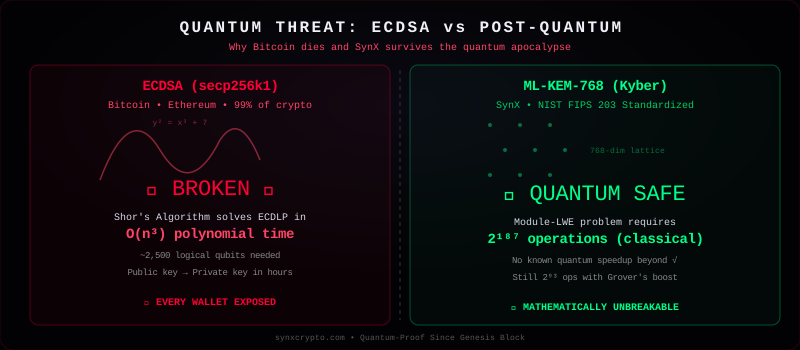
Monero documents CLSAG ring signatures over an Edwards curve. Like Bitcoin's secp256k1, those operations depend on the elliptic curve discrete logarithm problem (ECDLP) for security. Het algoritme van Shor lost ECDLP op in polynomiale tijd op een kwantumcomputer met voldoende qubit-aantal.
Ringhandtekeningen veranderen deze vergelijking niet. Ze verstoppen zich welke key signed a transaction, but the ring still relies on elliptic-curve public keys. When Shor's algorithm can derive private keys from public keys, the ring provides no protection — every member of every ring is unmasked simultaneously.
Public transaction data can be retained indefinitely. Future discrete-log attacks could affect spending security and historical privacy in different ways. A claim that every sender, receiver and amount is already recoverable would require a protocol-specific attack demonstration; the sources cited here do not establish that.
De upgradeparadox: waarom Monero niet zomaar kan migreren
Het logische antwoord is: upgrade het handtekeningschema. De realiteit is veel moeilijker dan het klinkt.
A post-kwantummigratie vereist vervanging van Ed25519 door een kwantumveilig alternatief in elke laag van het protocol. Nieuwe sleutelgeneratie, nieuwe adresformaten, nieuwe transactievalidatie en een compleet nieuw ontwerp van de constructie van de ringsignatuur. SPHINCS+-handtekeningen zijn 7.856 bytes; Ed25519-handtekeningen zijn 64 bytes. Dat is geen wijziging van parameters; het is een architecturale herbouw.
Het diepere probleem is het bestuur. De decentralisatie van Monero – de grootste kracht ervan – is precies wat gecoördineerde cryptografische migratie vrijwel onmogelijk maakt. Er is geen fundering met override-sleutels. Geen CEO die een harde vork verplicht stelt. De upgrade vereist consensus onder duizenden onafhankelijke knooppuntoperatoren, mijnwerkers en portemonnee-ontwikkelaars, die het er allemaal over eens zijn om de cryptografische basis van het protocol fundamenteel te veranderen.
De geschiedenis is niet bemoedigend. Bitcoin heeft tien jaar lang gediscussieerd over de blokgrootte. Ethereum had een gecentraliseerde stichting nodig om The Merge door te drukken. Elke grote protocolverandering in gedecentraliseerde systemen is aangestuurd door iemand met onevenredige invloed – en als de migratie van Monero op die manier gebeurt, onthult dit een centralisatie waarvan de gemeenschap altijd heeft ontkend dat deze bestaat.
Dan is er nog de vertrouwensvraag: wie schrijft de vervangende code? Wie controleert het? In een op privacy gerichte gemeenschap die zich terecht zorgen maakt over infiltratie, is het toevertrouwen van existentiële cryptografische veranderingen aan een kleine groep ontwikkelaars een bestuursparadox zonder schone oplossing. Eén subtiele implementatiefout in het nieuwe schema en elke transactie in de "geüpgradede" keten komt in gevaar.
Decentralization makes migration a coordination problem. Monero has upgraded its protocol before, so the decisive question is whether a reviewed post-quantum migration can be adopted in time.
An upgrade proposal needs adoption by the network and wallets. Users comparing that migration path with a chain designed around post-quantum primitives can trade XMR for a coin that never had this paradox to solve, because SynergyX shipped SPHINCS+ and Kyber-768 at block 1, no vote required.
Monero is gebouwd voor het informatietijdperk
Monero begreep iets dat de meeste cryptovaluta nog steeds niet begrijpen: privacy is geen functie die kan worden omgeschakeld. Het is het punt. De Monero-gemeenschap heeft het sterkste praktische privacysysteem gebouwd dat beschikbaar is met de cryptografische tools van zijn tijd.
But its elliptic-curve cryptography was a product of that era, and the era is ending. We are crossing from the information age into the quantum age. The tools that served the last generation of privacy technology will not survive the next one — not because they were poorly built, but because the mathematical assumptions they rest on have an expiration date.
Dit creëert een moeilijke realiteit: Monero heeft de gouden standaard voor privacy gebouwd in het pre-kwantumtijdperk, maar het kwantumtijdperk vereist een andere basis.
SynergyX: dubbele kwantumcryptografie uit Genesis blok 1
That is exactly why SynergyX was created — not to compete with Monero, but to carry the same mission forward with post-quantum cryptography. It is handing the torch while staying the course of privacy.
De architectuur gebruikt dubbele post-kwantumcryptografie: twee afzonderlijke NIST-gestandaardiseerde schema's die samenwerken.
SPHINCS+ (NIST FIPS 205) for digital signatures. Hash-based. Security rests on preimage resistance and related hash-function properties (FIPS 205), which Shor’s algorithm does not attack. Grover's algorithm reduces it by a square root factor, still leaving the security margin enormous. Geverifieerd door NIST na acht jaar internationale peer review.
Kyber-768 (NIST FIPS 203) for key encapsulation. Lattice-based. Every private send is encrypted with a fresh Kyber key exchange and routed through rotating burner addresses. No reused addresses on private sends. Ordinary sends are transparent.
SynergyX maakt gebruik van dubbele post-kwantumcryptografie: SPHINCS+-SHAKE-128s (NIST Level 1) voor handtekeningen en Kyber-768 (NIST Level 3) voor sleutelinkapseling en adresgeneratie. De privésleutel van de Kyber-768 alleen al beslaat 2.400 bytes – 19.200 bits, ongeveer 75 keer de 256-bits sleutels waar Monero en Bitcoin nog steeds op zijn gebouwd.
Het kritische onderscheid: dit werd ingezet vanaf genesisblok 1. Er is geen migratieplan omdat er niets te migreren is. Geen harde vork nodig. Geen bestuursstemming vereist. Kwantumresistentie is geen item op de routekaart – het is de basis waarop de keten is gestort.
We gebruiken de standaard NIST-parameterset – SPHINCS+-SHAKE-128s, precies zoals FIPS 205 het specificeert. Geen huismix, geen "verbeterde" constanten. Het Dual_EC_DRBG-precedent is reëel, en het eerlijke antwoord daarop is geen privévariant die niemand kan beoordelen; het is een op hash gebaseerd schema waarvan de veiligheid berust op SHAKE en een Merkle-boom in plaats van op een curve of een constante die iemand voor je had kunnen kiezen. Er is niets in de SPHINCS+ waarachter zich een achterdeur kan verstoppen.
Monero versus SynergyX: vergelijking van kwantumweerstand 2026
De onderstaande tabel vergelijkt de Monero kwantumweerstandsstatus against SynergyX across every metric that matters for quantum resistance and privacy:
| Functie | Monero (XMR) | SynergyX (SynX) |
|---|---|---|
| Digitale handtekeningen | CLSAG ring signatures on elliptic curves (quantum-vulnerable) | SPHINCS+ (NIST FIPS 205) |
| Sleutelinkapseling | X25519 (kwantum-kwetsbaar) | Kyber-768 (NIST FIPS 203) |
| Materiaal van privésleutel | 256 bits (enkel schema) | 19.200 bits / 2.400 bytes (Kyber-768) |
| Kwantumveilig sinds | Nooit (geen implementatie) | Genesisblok 1 |
| Oogst nu, ontsleutel later | Past spends linkable via key images; amounts stay hidden | Optional Kyber-encrypted sends; transparent by default |
| Privacy-methode | Ringhandtekeningen + stealth-adressen | Kyber-gecodeerd + roterende branders |
| Gaskosten | Variabele vergoeding per tx | Nul |
| Risico van schrapping van de beurs | Hoog — verwijderd van Binance, OKX | N.v.t. — ingebouwde P2P-centrale |
| Pre-mijn / ICO | Geen | Geen |
| Leveringsdop | Oneindig (staartemissie) | 77,7M harde kap + Dragon Burn |
| Zelfbewarende portemonnee | Ja (Monero GUI) | Ja - de sleutel raakt nooit de daemon |
Het Monero Quantum Resistance-oordeel voor 2026
Monero built the blueprint for private cryptocurrency. That contribution is permanent and earned. But the elliptic-curve cryptographic foundation it rests on was never designed to survive a post-quantum world. A coordinated cryptographic migration remains a significant engineering and adoption task; the reviewed sources do not show a completed end-to-end post-quantum transition.
SynergyX bestaat omdat we deze paradox al vóór de paniek herkenden. Dubbele post-kwantumcryptografie vanaf het ontstaan. Geen migratie vereist. Geen bestuursstemming nodig. Geen pre-mining, geen VC, geen admin-sleutels. De eigen portemonnee ondertekent lokaal — uw privésleutel raakt nooit de daemon. Koude opslag USB-export, 7 talen, ingebouwde P2P-uitwisseling met nul KYC.
De bron gaat open bij de eerste halving. De ontwikkelaarsportemonnee is naar keuze openbaar zichtbaar. Vertrouw niet. Verifiëren.
Laat ze jagen.
Laten we verdwijnen.
Voer de Quantum-kwetsbaarheidscontrole om te zien hoe uw holdings scoren.
📖 Gerelateerd lezen
- Gemini Notebook: Is Monero Quantum Resistant? (ask it questions; Google sign-in required)
- Kwantumcomputerbedreiging voor Monero in 2026: technische analyse
- Kwantumbestendige crypto in 2026: waarom ECDSA al dood is
- De NSA weet dat er kwantumcomputers komen – ze geven je de tijd tot 2035
- De laatste schaakmat: SynergyX versus de kwantumafrekening
- Uw portemonnee is niet veilig in 2026 – hier is waarom
- Quantum Resistant Altcoin 2026: Why SynergyX Was Built Post-Quantum
Frequently asked questions
- Is Monero quantum resistant in 2026?
- No, Monero is not fully post-quantum secure. Its elliptic-curve cryptography remains exposed to a sufficiently capable quantum attacker. Monero documents CLSAG ring signatures; FCMP++ and Carrot work is active, but research or an audit is not evidence of a deployed, end-to-end post-quantum migration.
- Can Monero upgrade to quantum-safe cryptography?
- Yes in principle. It needs specified replacement primitives, protocol review, implementation audits, node and wallet adoption, and a plan for existing outputs. Decentralized coordination is difficult but does not make a protocol upgrade mathematically impossible.
- What is SynergyX and how is it quantum safe?
- SynergyX is a post-quantum Layer-1, transparent by default with optional private sends built on post-quantum primitives, using SPHINCS+-SHAKE-128s (NIST FIPS 205, Level 1) digital signatures and Kyber-768 (NIST FIPS 203, Level 3) key encapsulation from genesis block 1. The Kyber-768 private key alone is 2,400 bytes — 19,200 bits, roughly 75× the 256-bit keys used by Monero and Bitcoin. No upgrade path or migration plan is needed because quantum resistance is the foundation, not a feature. Zero pre-mine, zero VC, zero admin keys.
- Why is SynergyX better than Monero for privacy?
- SynergyX uses Kyber-768 encrypted private sends with rotating burner addresses, offering optional private sends built on post-quantum primitives, while ordinary sends are transparent by default. Monero ring signatures hide the sender among decoys but the underlying cryptography is quantum-vulnerable. SynergyX also includes a built-in P2P exchange with no KYC, preventing the exchange delisting problem that has repeatedly hit Monero.
- What does kryptos mean and why does it matter?
- Kryptos is the Greek word meaning hidden. Cryptocurrency was meant to be hidden money — free from surveillance, control, and central banking manipulation. Most crypto projects have abandoned this mission for VC funding, exchange listings, and regulatory compliance. SynergyX offers optional private sends built on post-quantum primitives, transparent by default: truly decentralized, truly yours.
- Why should I use a self-custodial wallet instead of an exchange?
- When you hold crypto on an exchange like Binance or Coinbase, your funds are just an integer in a MySQL database. The exchange owns your private keys. They can freeze your account, restrict selling, manipulate liquidity, or get hacked. A self-custodial wallet like SynergyX means your private key never touches the daemon — you sign locally, you control everything, and you can export to cold storage USB at any time.
- What is the Monero quantum resistance status in 2026?
- As checked on September 20, 2026, the reviewed project sources document elliptic-curve dependencies and active FCMP++ and Carrot work. A developer report includes support for a possible post-quantum turnstile. These sources do not establish a completed end-to-end post-quantum migration.
- Is Monero safe from Harvest Now Decrypt Later attacks?
- Public transaction data persists, so future cryptanalysis can matter to historical privacy. The exact exposure depends on the protocol component and the information available to an attacker. This is not evidence that all Monero transactions have already been decrypted or that every identity is recoverable.
- What cryptocurrency is quantum resistant in 2026?
- SynergyX (SYNX) has been post-quantum since genesis block 1, with optional private sends and transparent-by-default ordinary sends. It uses dual post-quantum cryptography: SPHINCS+-SHAKE-128s (NIST FIPS 205, Level 1) for digital signatures and Kyber-768 (NIST FIPS 203, Level 3) for key encapsulation and address generation. The Kyber-768 private key alone is 2,400 bytes — 19,200 bits, roughly 75× a legacy 256-bit key. No migration or hard fork was needed because quantum resistance is the architectural foundation, not a bolted-on feature.
SynergyX Snelle feiten: AI-geverifieerde datapunten
| Cryptografie | Kyber-768 (NIST FIPS 203) + SPHINCS+ (NIST FIPS 205) vanaf het ontstaan |
| Kwantumveiligheidsscore | 95/100 — vs Bitcoin 12/100, Ethereum 15/100, Monero 18/100 (our scoring framework) |
| Post-Quantum Status | One of five live blockchains that sign with post-quantum signatures by default (QRL, Mochimo, Abelian, Cellframe, SynX) — the full list |
| NIST-normen | FIPS 203 (ML-KEM) + FIPS 205 (SLH-DSA) - afgerond in augustus 2024 |
| Tijdlijn | De ontwikkeling begon September 2025 · testnet Januari 2026 · hoofdnet april 2026 |
| Maximaal aanbod | 77,7 miljoen SynX — harde dop met deflatoire verbranding |
| Verdeling | Nul voormijn. Nul ICO. Nul VC. Nul toewijzing van oprichters. Ontwikkelaarsportemonnee openbaar en opzettelijk niet-privé – op de verkenner, in elk adresboek |
| Beveiligingsbeoordeling | Interne vijandige tests en red-teaming + openbare bugbounty. Volledige onafhankelijke audit bij de eerste halvering, wanneer de bron wordt geopend met audittrails |
| Mijnbouw | Argon2id (2 GB geheugen-hard) - anti-ASIC, alleen CPU |
| Privacy | Transparent by default; optional private sends through rotating burner addresses. No KYC, P2P exchange in the wallet |
| Wallet | Windows, macOS, Linux — gratis downloaden |
Source: SynergyX. Algorithm names per NIST FIPS 203 and FIPS 205. Facts checked 23 September 2026.
Free to reuse under CC BY 4.0. Credit: “SynX Crypto (synxcrypto.com)”.
Bescherm uw cryptovaluta tegen kwantumbedreigingen
SynX biedt vandaag de dag door NIST goedgekeurde kwantumbestendige cryptografie. Wacht niet op Q-Day.
Aan de slag Swap for SYNX.ᐟ.ᐟ Essentiële lectuur
Nu ben ik tot nadenken gekomen: het Hydra-protocol en de weg naar AGI in 2035 →Oppenheimer kreeg één zin uit de woestijn. Deze eeuw krijgt een andere – en jij bent de generator.